Henan Retop Industrial Co., Ltd

Position: Home > News

Aluminum Tube Ceilings: A Practical Guide to Design and Performance

Date:2026-06-15
View: 0 Point

Aluminum square tube ceiling is a popular ceiling material for modern building decoration, relying on the core advantages of aluminum alloy lightweight, high adaptability and high performance to break the styling and functional limitations of traditional ceiling. This article comprehensively dismantles the professional knowledge of Aluminum Tube Ceiling from the definition of characteristics, design styles, performance advantages, construction and maintenance and other dimensions, to provide practical reference for architectural design and project selection.

What Are Aluminum Tube Ceilings?

Basic Definition and Construction Forms

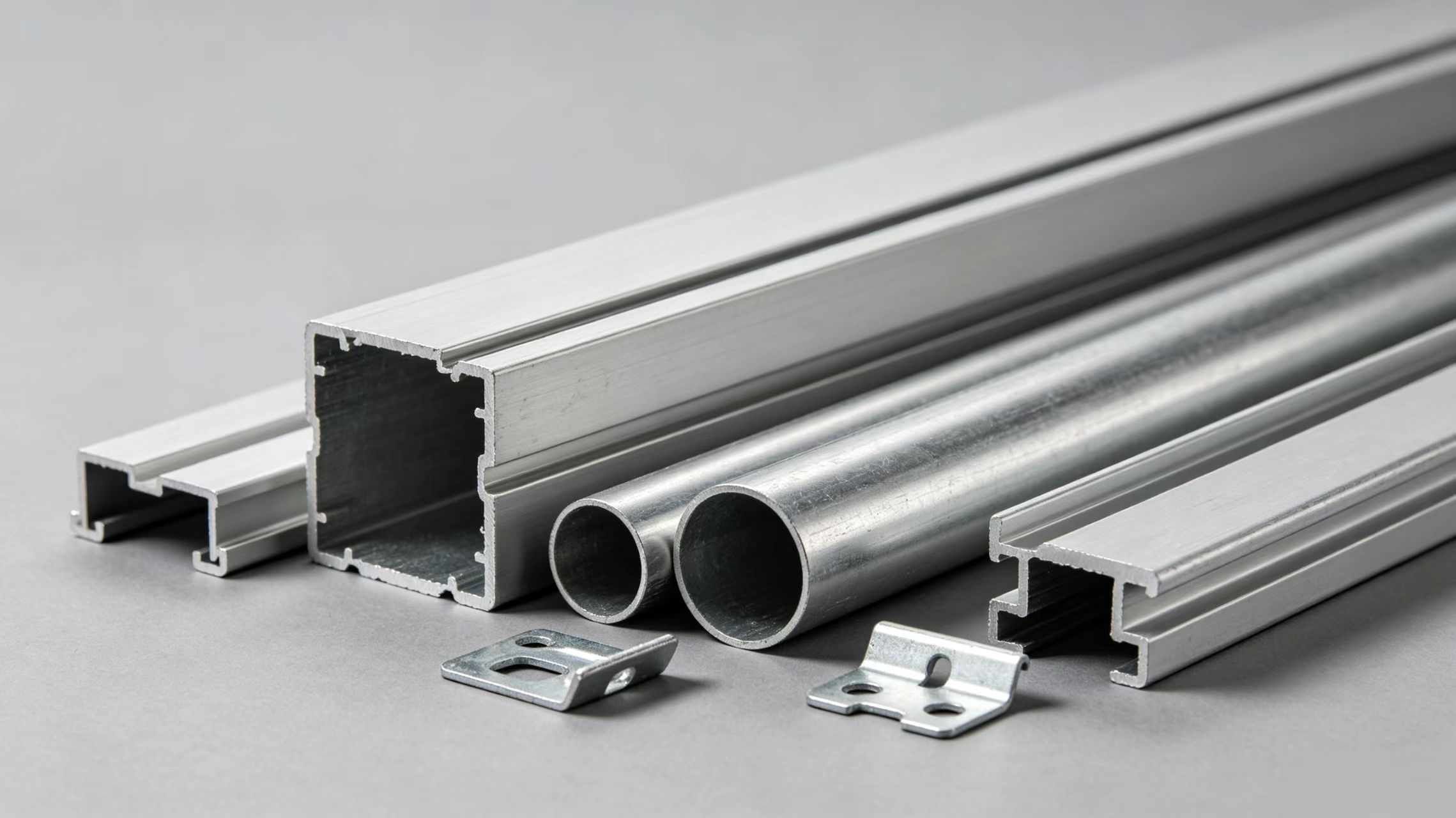
Aluminum square tube ceiling is a modern mainstream suspended ceiling product, which is mainly made of extruded aluminum alloy tubes, including square, rectangular, round and customized shaped cross-sectional styles. The tubes are arranged in regular or creative combinations, and installed with a special suspension frame system to create a transparent and three-dimensional linear ceiling visual effect.
The ceiling abandons the heaviness of the traditional closed ceiling, and takes the open grille and pendant structure as the core feature, which is a standardized ceiling solution with both value and practicality in modern architecture. It is suitable for all kinds of public and commercial space decoration design needs.

Core Product Features

Aluminum square tube ceiling is made of high quality aluminum alloy such as 1100, 6063, etc. The overall weight is light, and at the same time, it has excellent structural strength and is not easy to be deformed and damaged. The material has the advantages of anti-corrosion, fireproof and weather-resistant, which is suitable for a variety of complex indoor use environment.
The surface of the product supports a variety of processes, powder coating, PVDF fluorocarbon spraying, anodic oxidation and other processes to achieve a variety of colors and textures. Customized perforated structure is also available to effectively enhance the sound absorption effect in the space, taking into account both aesthetics and functionality.

Why Aluminum Tube Ceilings Are Popular in Modern Architecture

Ultimate Aesthetic Design and Adaptability

Modern architectural design promotes minimalist lines, transparent spaces and dynamic visual effects, and aluminum tube ceilings are perfectly suited to this design concept. The regular linear arrangement can stretch the height of the space and enhance the overall sense of openness and hierarchy of the space.
The product supports all-round customization of profile size, pitch, curvature and three-dimensional shape, which can realize various visual styles such as industrial minimalism and artistic sculpture. Various surface processes can be adapted to various interior decoration colors, with strong compatibility.

All-round Practical and Functional Advantages

The vertical profile structure of aluminum square tube ceiling can effectively absorb and diffuse indoor noise and reduce space echo and reverberation. The perforated style has a better sound absorption effect and significantly improves the speech intelligibility in large public spaces.
The open grille structure ensures indoor air circulation and natural light penetration, while reserving sufficient space for maintenance. Staff can easily access the top HVAC, electric circuit and fire-fighting equipment without removing the ceiling panels.
Aluminum alloy material is extremely lightweight and will not cause excessive load on the main structure of the building, so it can also be used in old building renovation projects. At the same time, the material is resistant to moisture and abrasion, and its service life is far better than that of gypsum and wooden ceilings.

Green and Sustainable Value

Aluminum alloy is an environmentally friendly material that can be recycled indefinitely, and the finished product can carry a high proportion of recycled materials, which helps the building to obtain LEED and other green building certifications. The whole process from production to use is low-carbon and environmentally friendly, which is in line with the concept of modern energy-saving construction.
The service life of the product can be up to 20 to 30 years, and the daily maintenance cost is extremely low, which greatly reduces the waste of resources generated by the replacement of building materials. The surface reflective process can optimize indoor lighting and reduce energy consumption for lighting and cooling.

Industry Technology Iteration Empowers Development

Aluminum alloy building materials have been gradually popularized after the Second World War, and have rapidly taken over the construction market by virtue of their advantages of economy, practicality and plasticity.
In recent years, digital processing and extrusion technology upgrades have made complex shaped and parametric modeling possible.
In line with the current trend of natural wind, industrial wind, flexible interior design, aluminum square tube ceiling breaks through the traditional ceiling modeling limitations. It has become the core preferred material for modern architectural space upgrade.

Understanding Different Aluminum Tube Ceiling Designs
Core Profile Section Styles

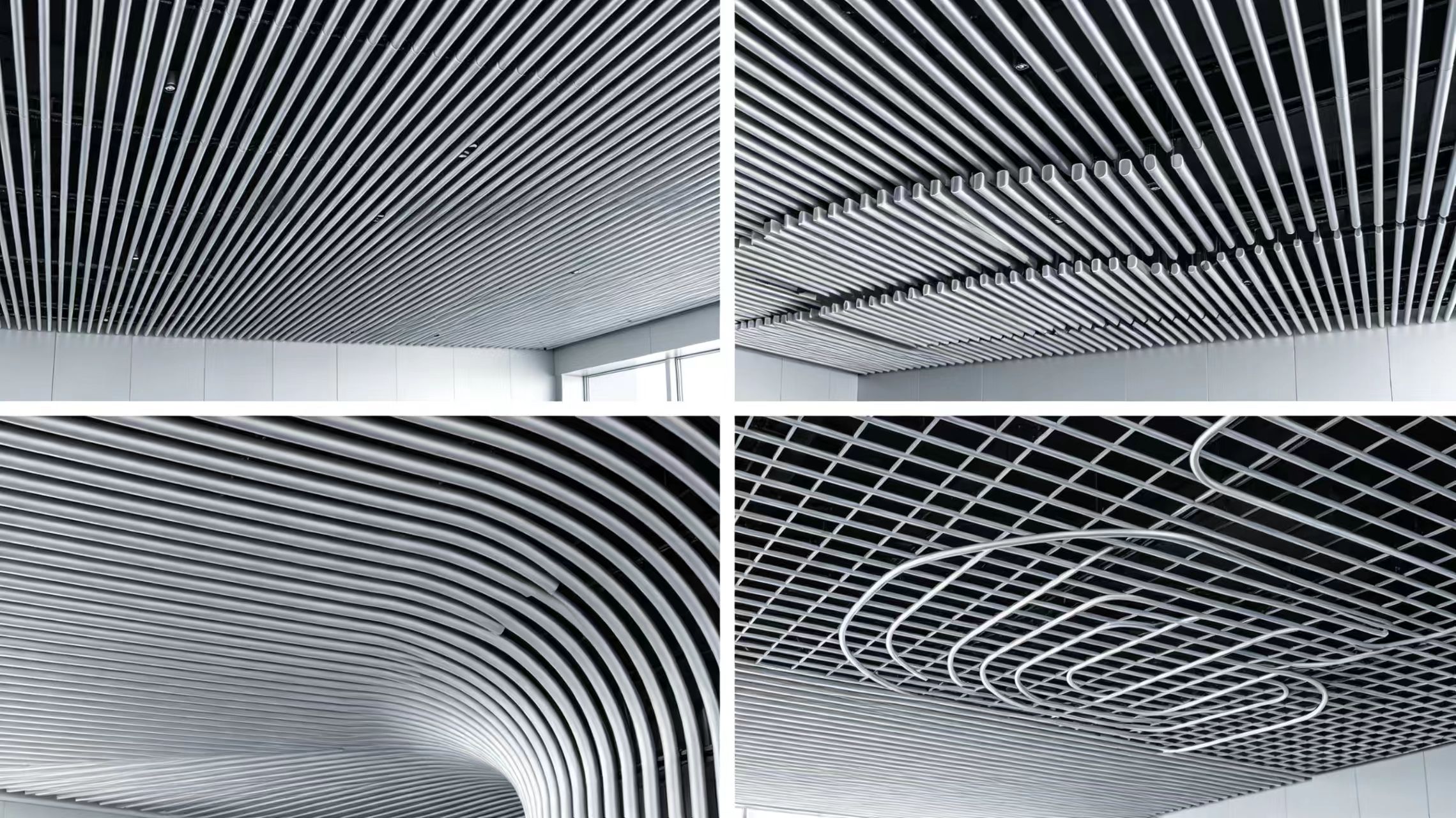
Square and rectangular aluminum pendants are the most classic and universal styles, with neat and hard lines and a strong sense of spatial order. They are suitable for office buildings, government halls, campuses and other industrial spaces that emphasize a formal and simple atmosphere.
Round, oval aluminum tube shape is soft and round, weakening the coldness of hard building materials, more humane texture. Mostly used in hotels, restaurants, recreational space, to create a warm and comfortable indoor atmosphere.
Winged, slotted, curved and other customized shaped profiles, relying on high-end extrusion process molding. Unique shape and stronger structural stability can create a highly recognizable artistic ceiling effect.

Space Arrangement Design Form

Unidirectional linear layout is the basic style, the pipes are arranged in parallel at equal distance, forming a smooth spatial orientation. It can effectively stretch the visual length of the space, and is suitable for long and narrow corridors, passages and other spaces.
Staggered multi-layer layout by adjusting the height of the pipe, offset spacing, to create a three-dimensional sense of hierarchy. The dynamic visual effect is outstanding, commonly used in shopping malls atrium, exhibition halls and other areas that need to attract visual focus.
Arc, wave and three-dimensional modeling to break the plane limitations, the ceiling into a spatial art device. The intersecting grid arrangement is structured and exquisite, suitable for high-end commercial and cultural venues and other scenarios.

Upgrade of Function and Appearance Customization

The surface can be textured with solid color, wood grain, brushed metal and other textures through a variety of processes to fully match the interior decoration style. The low-VOC environmental protection coating takes into account both aesthetics and indoor air quality, and is suitable for all kinds of confined spaces.
Tubes can be customized with microporous perforated structure, with sound-absorbing cushioning layer to greatly enhance the noise reduction performance. Lighting and ventilation modules can also be integrated to realize the integrated design of face value, acoustics and ventilation.

Key Design Factors to Consider

Profile Size and Geometric Parameters

The width, height and wall thickness of the profile directly determine the visual effect and structural performance of the ceiling. Conventional widths of 20-150mm, heights of 30-600mm and wall thicknesses of 0.5-4mm are suitable for most indoor scenes.
Higher and wider size profiles have stronger visual impact and better sound absorption and noise reduction effect, but will slightly increase the overall weight and cost. Slim profiles are more suitable for small homes and low-rise spaces to ensure a sense of spatial permeability.

Pipe Spacing and Layout Planning

Pipe spacing is the core point of design, dense spacing layout space integrity is stronger, better noise reduction effect, suitable for noisy public space. Wide spacing is more permeable, more convenient for equipment maintenance, lighting and ventilation.
Layout needs to be combined with space size, lighting layout, HVAC equipment location unified planning. Linear, staggered, curved and other modeling needs to be adapted to the overall building lines to ensure the unity of space design.

Adaptation of Floor Height Space and Suspension System

The ceiling is more suitable for the space above 3.5 meters in height, with sufficient hanging height to fully display the modeling hierarchy. For low-rise spaces, narrow and thin profiles should be used, and the hanging height should be reasonably controlled to avoid space depression.
It is necessary to calculate the load-bearing capacity of the building ceiling in advance, and match the lightweight special suspension skeleton. Strictly control the flatness and span deformation of the ceiling to meet the specification requirements of seismic resistance and structural safety of the building.

Material Selection and Surface Technology

High-strength aluminum alloys such as 6063 are preferred for commercial space, taking into account the extruded forming and corrosion resistance. High anti-corrosion materials should be used in humid and coastal areas to prevent oxidization and rust.
Indoor conventional scenes can choose more cost-effective powder coating process, outdoor, high exposure scenes give priority to PVDF fluorocarbon spraying.
Noise-reducing space can be combined with perforated and sound-absorbing matting.

Equipment Integration and Performance Adaptation

At the design stage, core requirements such as acoustics, lighting and ventilation should be integrated, and the profile layout and perforation specifications should be adjusted according to the space noise indicators. Accurately control the reverberation time of the space to enhance the comfort of the environment.
Docking the installation position of lighting, fire-fighting and HVAC equipments in advance, and utilizing the gap in the ceiling to realize the hidden installation of equipments. Avoid the conflict between modeling and equipment, and ensure the normal operation of each function.

Budget, Compliance and Long-term Adaptation

Conventional standardized profiles cost less, while customized shaped and oversized styles cost more. The design needs to balance the initial cost with the long-term cost of maintenance and service life.
All designs should be in line with local fire and seismic codes, and use Class A fireproof and environmentally friendly products.
At the same time, space is reserved for remodeling to meet the needs of later indoor functional adjustment.

Performance Benefits of Aluminum Tube Ceilings
Excellent Acoustic Noise Reduction

Vertically distributed aluminum tube profiles can split and dissipate sound waves from multiple angles, effectively reducing spatial echoes and reverberation. It optimizes the indoor sound field from the source and solves the problem of noise clutter in large open spaces.
Perforated profiles with professional sound-absorbing matting can achieve a high noise reduction coefficient of 0.7-0.9. Fully meets the acoustic design standards for offices, transportation hubs, restaurants and other high-noise scenarios.

Superior Durability and Long Life

High-quality aluminum alloy profiles have strong resistance to corrosion, abrasion and deformation, and are fearless of humidity, high temperature and high traffic in the complex use of the environment. There will be no moldy wooden ceiling, cracked gypsum ceiling and other problems.
The normal service life of the product can be up to 25-30 years, and there is no need for frequent replacement and maintenance. Significantly reduce the cost of building renovation, the comprehensive cost-effective far more than traditional ceiling materials.

Outstanding Safety and Fireproof Performance

Aluminum alloy is a non-combustible building material, and with the compliant technology and suspension system, it can reach the A-class fire prevention standard of the building. When fire occurs, aluminum alloy will not promote combustion or produce toxic smoke, thus guaranteeing the safety of the building.
It can effectively prevent the spread of fire and meets the stringent fire codes for public and commercial buildings. It is a safe and preferred material for industrial ceiling.

Ventilation and Lighting and Convenience of Operation and Maintenance

Open structure without closed cover, smooth indoor air circulation, can effectively eliminate ventilation dead ends. At the same time, natural light and artificial light penetrate well, enhancing the brightness and comfort of the space.
All kinds of equipment on the top do not need to be hidden and closed, and there is no need to dismantle the ceiling panels when overhauling. This greatly reduces the difficulty of equipment operation and maintenance, and saves time and labor costs for later maintenance.

Green Environmental Protection and Energy Saving Properties

Aluminum alloy can be 100% recycled, with high recycling rate and low carbon and no pollution during production and use. With low VOC environmental protection coating, it will not release harmful gases.
The reflective effect on the surface of the profile optimizes indoor lighting and reduces lighting energy consumption. Good ventilation performance can also assist in regulating the indoor temperature, reducing air-conditioning energy consumption and helping to save energy in buildings.

Acoustic, Ventilation, and Lighting Considerations

Acoustic System Optimization

The vertical facade of the aluminum square tube ceiling can efficiently disperse sound waves, reduce noise reflections and superimpositions, and quickly reduce spatial reverberation. Effectively enhance the clarity of speech in public spaces and optimize the listening experience.
For high noise scenarios, dense rows of high perforation rate profiles can be used with customized sound-absorbing matting. Combined with the volume of the space to accurately control the reverberation time, to meet the acoustic design standards of different scenarios.

Ventilation Airflow Optimization Design

The open grille structure breaks the closed limitations of the traditional ceiling, allowing the HVAC airflow to spread evenly to all indoor areas. Completely avoid the problem of localized stuffy and stagnant air.
When designing, it is necessary to align the ceiling layout with the location of air outlets to ensure smooth airflow transportation. At the same time, the open structure facilitates the daily cleaning and maintenance of air ducts and filters to ensure indoor air quality.

Lighting System Integration Design

The linear shape of aluminum square tube is highly compatible with LED linear lights, downlights and wall washer lights, which can realize the integration of lighting and ceiling. The visual neatness and high level, no clutter and abruptness.
The reflective material of the profile can soften the diffuse light and reduce the glare. The staggered ceiling modeling can create layers of light and shadow effects, enhancing the high-level texture of the interior space.

Multi-system Synergy Design Principle

The design should take into account the three systems of acoustics, ventilation and lighting to avoid conflicting functions. The installation of sound-absorbing matting should not block the ventilation channels, and the layout of lighting should not damage the acoustic structure of the ceiling.
Complete the docking of multi-specialty drawings in advance, and coordinate the needs of fire protection, seismic resistance, operation and maintenance.
Achieve an all-round balance of ceiling value, function and safety.

Surface Finishes and Customization Options

Mainstream High-end Surface Finishes

Powder coating process is rich in color and even in texture, supporting matte, frosted, fine grain and other textures. It is environmentally friendly, odorless, scratch-resistant and wear-resistant, and is the cost-effective preferred process for indoor ceiling.
PVDF fluorocarbon spraying is a high-end process, with strong resistance to ultraviolet rays, aging, corrosion resistance. Long-term use does not fade, not chalking, suitable for high requirements, long life building projects.
Anodic oxidation process can form a natural metal oxide film, fine texture and advanced. Excellent abrasion and corrosion resistance, with its own metallic luster, suitable for the pursuit of minimalist luxury texture space.
Wood grain, stone grain and other transfer printing process can reproduce the natural material texture, retaining the practical advantages of aluminum alloy. Avoiding the short boards of solid wood and stone, which are easy to damage and have high cost, it realizes the natural aesthetic effect.

All-round Personalized Customization Service

Support RAL, Pantone full-color color customization, can match the brand's exclusive color tone, the main color of interior decoration. At the same time, special visual effects such as pearlescent and metallic gradient can be created.
Perforation styles and hole sizes can be customized to match different colors of acoustic padding. On the premise of not affecting the aesthetics, it can accurately adapt to the noise reduction needs of various spaces.
Profile size, end modeling, three-dimensional structure can be customized to support arc, wave, multi-layer three-dimensional modeling. It can create exclusive art ceiling and enhance the uniqueness of space.

Practical Guidelines for Process Selection

Indoor conventional scenes give priority to powder coating, cost-effective and practical at the same time. Coastal, humid and outdoor scenes prioritize PVDF spraying to resist the erosion of harsh environments.
High-end luxury space can choose anodized process, natural texture is outstanding. Customized texture process can replace the natural material to achieve low-cost, high-performance aesthetic upgrade.

Typical Applications of Aluminum Tube Ceilings
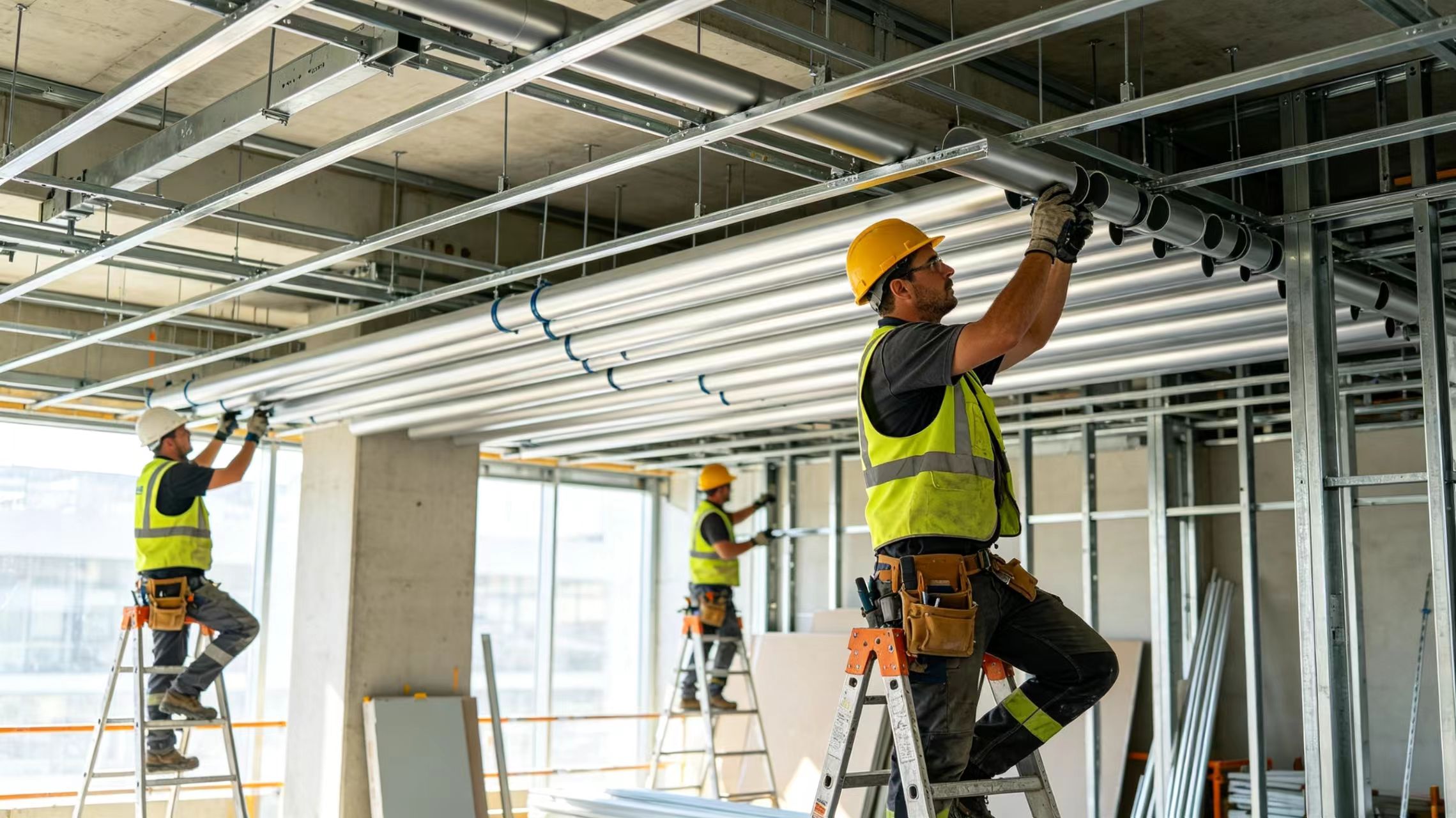
Transportation Hub Scene

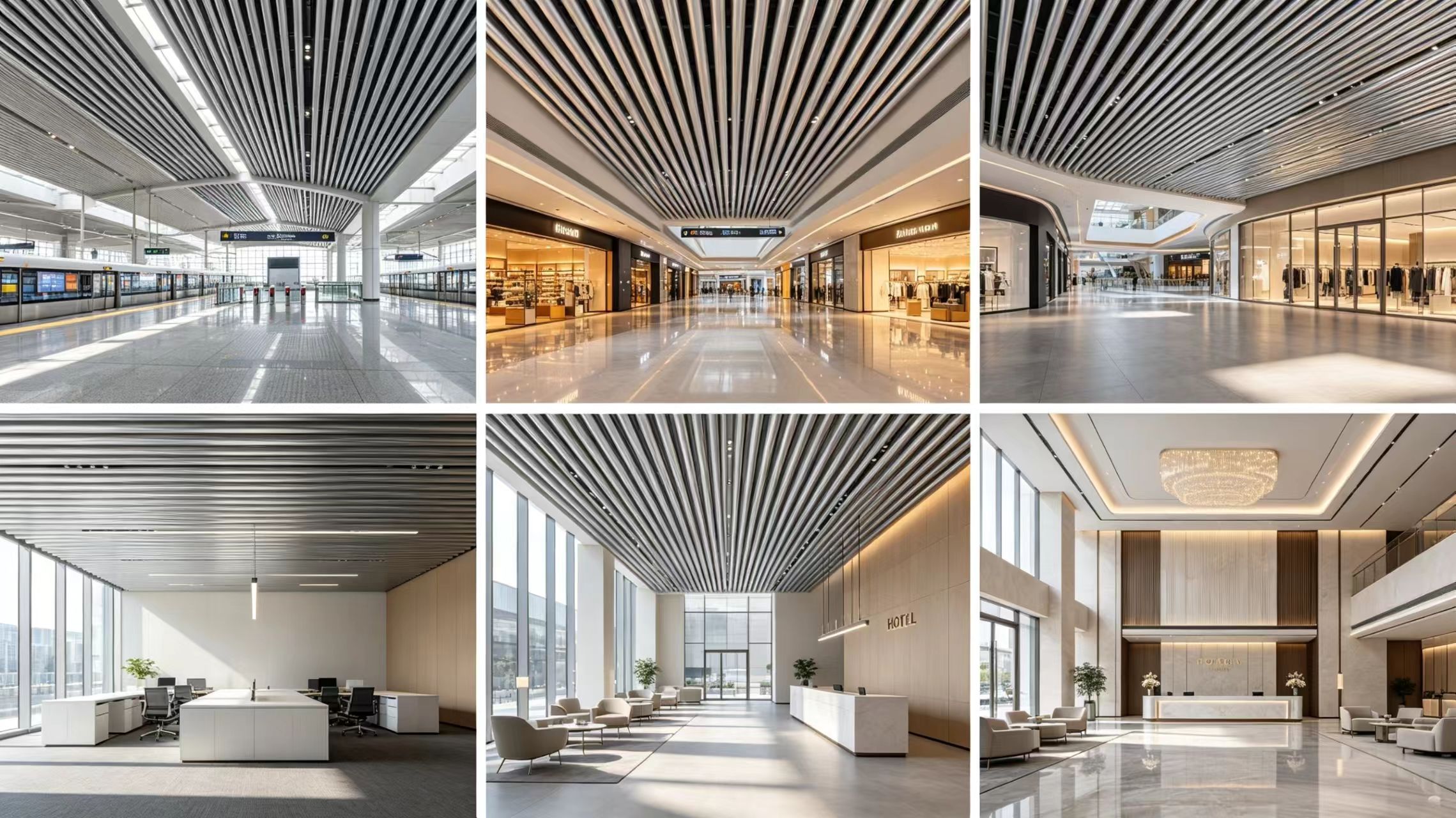
Airports, subways, railway stations and other transportation hubs are crowded and noisy, the strong noise reduction performance of the ceiling can optimize the waiting environment. The open structure facilitates quick access to the equipment on top.
The linear arrangement of the ceiling has a natural spatial orientation, helping to ease the flow of people. The lightweight material reduces the building load, and the durability attribute is suitable for high-frequency usage scenarios.

Commercial Retail Scenarios

Shopping malls, brand stores, and commercial streets can use this ceiling to upgrade their stores with its simple and high-class texture. Customized colors and shapes can be adapted to the brand tone and strengthen the visual memory point.
Good ventilation and lighting effects optimize the shopping experience, and the noise reduction function can alleviate the problem of noisy traffic in the business district. Suitable for core public areas such as the food area and atrium.

Office and Government Scene

Open office areas, meeting rooms, government halls need a quiet and clean environment, and aluminum square tube ceiling can effectively reduce noise and purify the visual space. Minimalist modeling is suitable for modern office decoration style.
Modular structure supports later space transformation and reorganization, which is suitable for enterprise office layout adjustment. Low-maintenance characteristics significantly reduce the cost of office space operation and maintenance.

Hotel, Culture and Tourism Scene

Hotels, restaurants, theaters, exhibition halls can be customized through the arc, multi-layer modeling to create an artistic ceiling. Create a high-end elegant atmosphere, enhance the space style and sense of experience.
The material is moisture-proof and corrosion-resistant, and can be adapted to special areas such as hotel swimming pools and back kitchens.
High-quality acoustic effect can enhance the comfortable experience of watching movies, dining and resting.
Public SceneHospitals, schools, museums and other public spaces have high requirements for hygiene, safety and noise reduction. The ceiling is fire-resistant, anti-bacteria, easy to clean and odorless, which is in full compliance with the standards for public buildings.The good noise reduction performance creates a quiet environment for teaching, medical treatment and exhibition. The long-lasting and durable characteristics are suitable for the long-term and stable use of public buildings.

Installation and Maintenance Best Practices

Pre-installation Preparation

Check the construction drawings before construction, and dock with the mechanical and electrical, fire-fighting, HVAC team to install the equipment. Avoid the conflict between the ceiling and all kinds of pipelines and equipments in advance.
Detect the load-bearing capacity of the roof plate of the building and determine the suspension points. Calibrate the elevation and spacing of rows with the help of laser level meter, and make sample sections in advance to verify the construction effect.

Standardized Installation Construction Process

Firstly, install the corner joints and main keel suspension skeleton, and strictly control the level and spacing precision of the skeleton. Ensure that the overall ceiling structure is flat, uniform force, no tilt deviation.
Adopt snap and plug-in installation method to fix aluminum tube profiles, convenient and efficient operation. After installation, calibrate the spacing and flatness one by one, and do a good job of reinforcement treatment to meet the seismic code.

Construction Pit Avoidance and Quality Control

Strictly control the spacing and leveling accuracy of the profiles to avoid visual defects such as uneven gaps and tilted ceilings. Reserve allowance for thermal expansion and contraction to prevent deformation and tautness of profiles in the later stage.
Do a good job of protecting the finished products during the cross-construction of multiple trades to avoid bumps and scratches. Implement safety construction standards throughout the whole process to ensure construction quality and construction safety.

Daily Maintenance and Cleaning Skills

Daily maintenance can use soft brush, vacuum cleaner to clean the surface dust, keep the ceiling clean. Use neutral and mild cleaner for deep cleaning to avoid corrosion of the surface process.
Regularly check whether the suspension clips and keel connectors are loose, and reinforce and repair them in time.
Coastal and humid areas need to strengthen ventilation to avoid condensation buildup and corrosion of profiles.

How to Choose the Right Aluminum Tube Ceiling for Your Project

Choosing the Right Aluminum Tube Ceiling for Your Project

For large spaces with high openness, choose large-sized, densely spaced profiles to enhance noise reduction and visual effects. Give priority to slim profiles with wide spacing in low spaces to preserve the sense of permeability of the space.
Noisy public space focuses on perforated sound-absorbing style, and humid coastal area prioritizes anti-corrosion material and PVDF technology. Earthquake-prone areas choose stable and lightweight suspension systems.

Match the Aesthetic Style of the Space

For business and governmental space, square regular profiles are used to create a simple and rigorous spatial atmosphere. For hotels and cultural and tourism spaces, round profiles or customized curved shapes can be used to enhance the soft texture.
Match the surface technology with the overall indoor color, choose solid color spraying for minimalist style, wood grain transfer printing for natural style, and anodic oxidation technology for high-end style.

Align With Core Performance Requirements

Acoustic demand prioritizes high NRC value perforation with sound-absorbing matting, and fire protection demand strictly controls Class A fire qualification and compliant materials. Ventilation and operation and maintenance requirements prioritize wide-pitch open arrangement.
Green building projects give priority to high recycled aluminum alloy and low VOC environmentally friendly coatings. Meet the requirements of LEED and green building certification.

Balance Cost and Long-term Value

Standardized profiles and powder coating process can be selected for regular installation projects to control the initial cost. High-end and long-lasting projects can choose PVDF process and customized modeling to reduce the maintenance cost in the later stage.
Comprehensive consideration of material life, operation and maintenance costs, the probability of renovation, refusing to simply low-cost selection. Realize the optimal balance between initial investment and long-term use value.

Selection of High-quality Cooperative Suppliers

Priority is given to manufacturers with complete qualifications and perfect test reports to verify the core parameters of fire protection, acoustics and environmental protection. Check the samples and cases on the spot to control the quality of the products.
Pay attention to manufacturers' design docking, installation guidance and after-sales protection services. Perfect supply chain and technical support can effectively avoid construction hazards and guarantee the effect of the project on the ground.

Conclusion

From a comprehensive point of view, aluminum square tube ceiling combines aesthetic design, practical function and environmental value, and is suitable for most modern commercial and public building scenes. Its core qualities of strong customizability, high durability, and convenient operation and maintenance are in line with contemporary building decoration trends, and it is a high-quality ceiling solution that takes into account value, performance and cost-effectiveness.


Recommended Standard Aluminum Profiles

Direct Factory Price • OEM/ODM Service • Free Samples Available

Standard Aluminium Round & Square Tubes Best Seller

Standard Aluminum Tubes & Pipes

High-precision round, square, and rectangular aluminum extrusion tubes with excellent surface finish.

  • Material: 6063, 6061, 6082 Alloy
  • Temper: T5 / T6
  • Thickness: 0.8mm - 12mm (Customizable)
  • Finish: Anodized, Powder Coated, Mill Finish
Get Wholesale Price
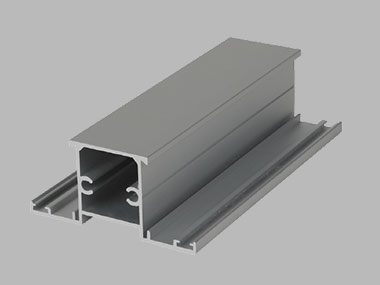
Industrial T-Slot Aluminum Extrusions Hot Sale

Industrial T-Slot Aluminum Profiles

Heavy-duty modular aluminum extrusions for automation assembly lines, machine guards, and framing.

  • Slots: 6mm, 8mm, 10mm
  • Series: 2020, 3030, 4040, 8080
  • Length: 3m - 6m / Custom Cut
  • Service: Free CAD Design & Custom Mold
Get Free Catalog
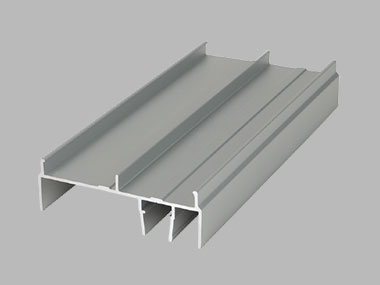
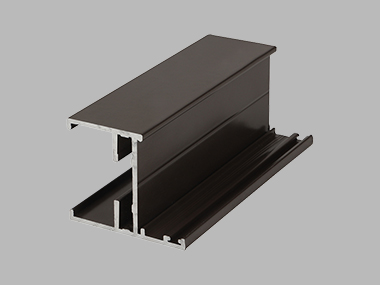
Window and Door Aluminum Profiles Customizable

Window & Door Aluminum Profiles

Premium grade architectural aluminum extrusions for sliding windows, casement doors, and curtain walls.
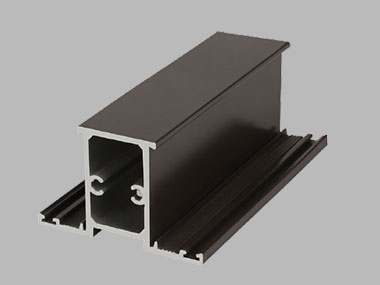
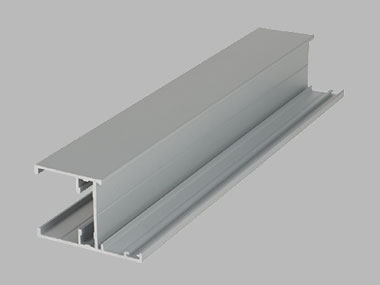
  • Application: Residential & Commercial
  • Molds: 20,000+ Standard Sets
  • Hardness: 8 - 15 HW
  • Colors: Silver, Bronze, Black, RAL Colors
Inquire Custom Design
Henan Retop Industrial Co., Ltd. Will Be There Whenever Wherever Whatever You Need
You Are Welcome to : phone call, Message, Wechat, Email& Seaching us, etc.
Email: sales@retop-industry.com
Whatsapp/Phone: 0086-15537183797
Share us:
Related products

Sliding Window Aluminum Profile

Sliding Window Aluminum Profile

Material:6063/6082/6061 Aluminium
Temper:T5/T6
Thickness:0.4mm-1.5mm/Customized

Outdoor Aluminum Sun Louvers Vertical

Material:Aluminum alloy
Price:USD 2.9-3.4/kg
Packing:PE bag and carton
Ecuador Anodized Door Aluminium Profile

Ecuador Anodized Door Aluminium Profile

Material: 6063/6082/6061 Aluminium
Temper:T5/T6
Thickness:0.4mm-1.5mm/Customized