How Custom Aluminum Fabrication Enhances Efficiency
Date:2026-06-22
View: 0 Point
Custom aluminum processing has become a key solution for manufacturing and construction industries to reduce costs and increase efficiency with flexible profile design and supporting processes. Compared with standard aluminum, it can optimize the structure according to the working conditions, optimize the process from raw materials, assembly, supply chain and other dimensions, to achieve capacity enhancement, cost control and environmental protection balance, to meet the needs of the development of multiple fields.
What Is Custom Aluminum Fabrication?
Various Value-added Processes
Basic Precision Forming Processes
Custom aluminum processing is not only simple aluminum extrusion, but also a full set of finishing processes, covering the entire basic processing from raw material cutting to component shaping, to meet the molding needs of various types of non-standard aluminum parts. The whole set of basic process includes CNC milling, high-precision drilling and cutting, and at the same time with CNC bending and profile cold bending molding process, to meet different curvatures and specifications of aluminum molding processing.
Surface Treatment and Supporting Deep Processing Processes
The complete processing system includes aluminum welding, integrated assembly of multiple parts, and a variety of protective and decorative surface treatment processes such as anodizing, powder coating and mirror polishing. In addition, it also includes punching, burr cleaning, laser marking, hardware pre-installation and other auxiliary processes, one-stop finished product processing, eliminating the cumbersome process of multiple outsourcing and docking.
The Complete Process of Custom Aluminum Processing
Pre-drawing Docking and Aluminum Alloy Grade Selection
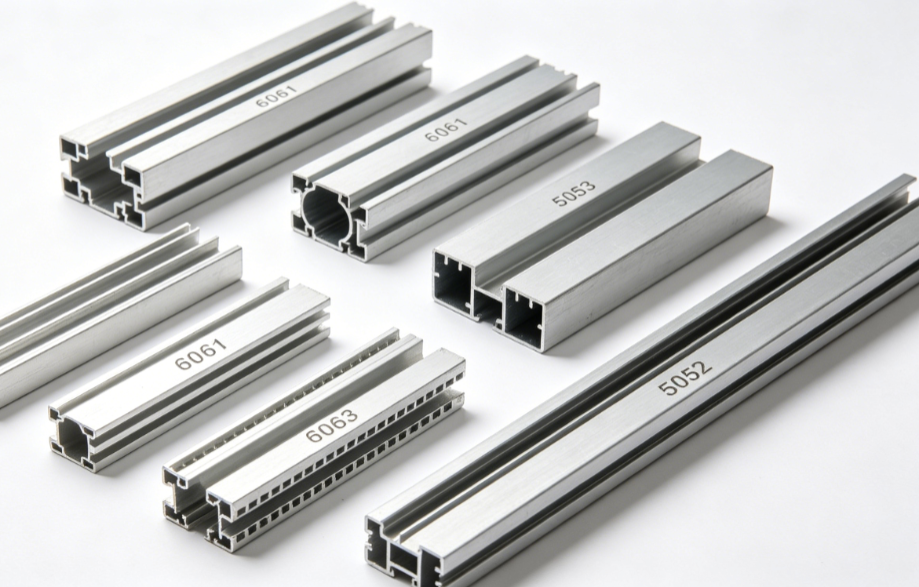
At the project initiation stage, the enterprise provides hand-drawn drawings and 3D CAD files, and engineers intervene simultaneously to optimize the structure, adjust the dimensions from the perspective of extrusion feasibility, and enhance the manufacturability of the solution. According to the usage environment and load-bearing requirements, we matched the corresponding alloys. 5052 aluminum alloy is suitable for sheet metal bending processing, while 6061 and 6063 alloys are mostly used for high-precision extruded profiles for mass production.
Mold Making, Extrusion and Secondary Finishing Processes
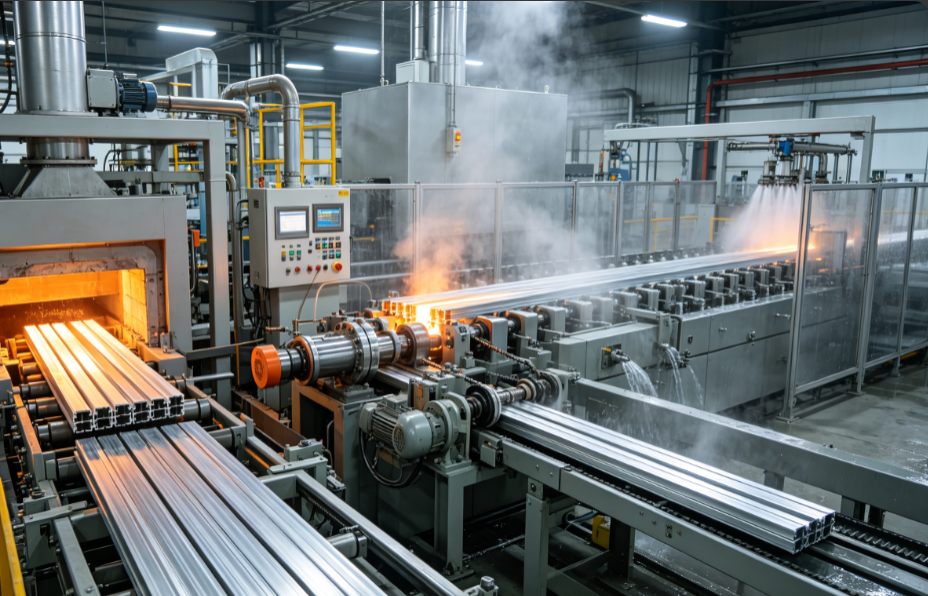
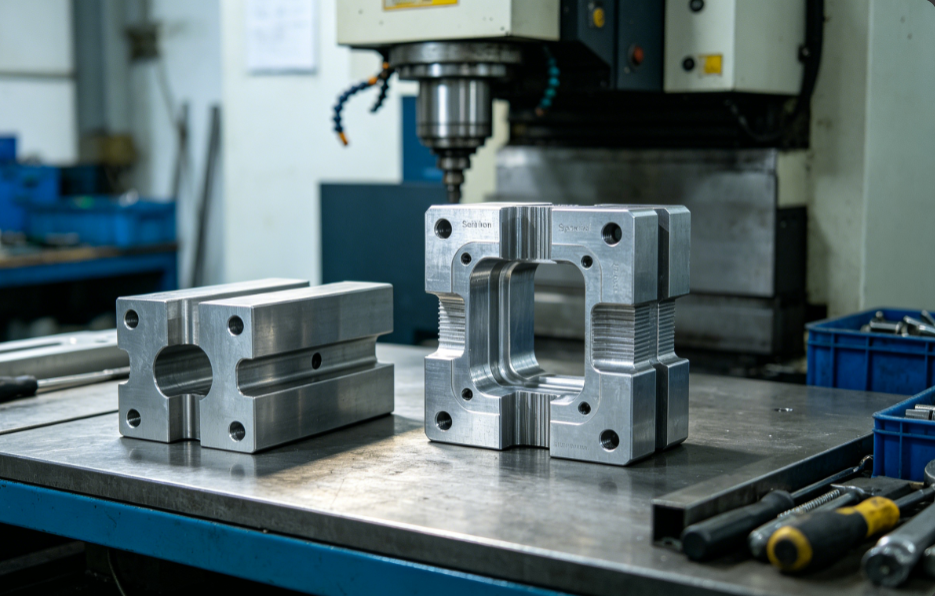
For special non-standard cross-section profiles, the factory will open a separate extrusion die, debug the temperature, pressure and other equipment parameters, complete the extrusion of aluminum rods, and produce basic profile blanks. After the extrusion is completed, the profile will also go through secondary processes such as CNC cutting, hole machining, surface treatment, etc. After the closed-loop processing of multiple processes, the aluminum products will be assembled and inspected to obtain qualified customized products.
How Custom Fabrication Improves Production Efficiency
Structure Optimization
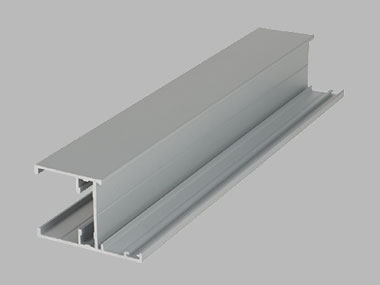
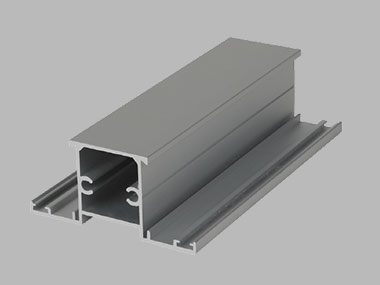
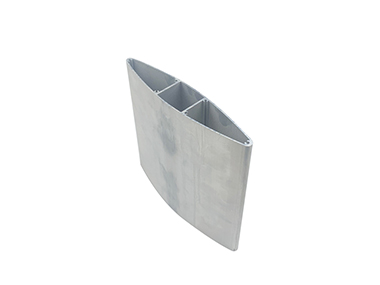
Customized extruded profiles can be molded with built-in mounting grooves, heat dissipation fins, alignment fixed card position and other composite functional structures, without the need to install various types of accessories separately later. A single composite profile can replace a number of piecemeal standard fittings, reducing the number of screws and connectors, simplifying the assembly process, and reducing the probability of product failure caused by loose splices.
Streamlined Cutting Process
The custom extrusion process produces near-net-size profiles, with shape specifications that are infinitely close to the finished product requirements, without the need for large-area milling and grinding, which significantly improves the overall utilization rate of aluminum raw materials. Aluminum cutting difficulty is much lower than steel and stainless steel, with high-speed CNC machining equipment, reduce tool loss, and simultaneously accelerate the overall speed of the workshop finishing, edge processing.
Uniformity of Dimensional Accuracy
The processing factory customizes the precise tolerance according to the workshop assembly and site installation conditions, and the profile interface is tight and seamless, so that it can be directly assembled after delivery to the site, eliminating the need for manual re-holing, cutting and polishing processes. Modular customized aluminum components are suitable for assembly construction and assembly line assembly mode, which greatly shorten the manual construction time and reduce the cost of work stoppage and delay caused by the handover of work processes and size inconsistency.
One-stop Full-process Service
Professional customized manufacturers independently complete the whole process of extrusion, CNC machining, surface spraying, and assembly of finished products, so that enterprises do not need to dock with a number of outsourcing suppliers, which significantly reduces the cost of communication between multiple parties. Relying on intelligent CAD design and automated sampling equipment, we can compress the cycle of sample debugging and production, help enterprises realize just-in-time production, and steadily control the overall rhythm of order delivery.
Adaptation to Automated Production Lines
Mechanical alignment slots and standardized docking interfaces are reserved at the profile design stage, which can be perfectly adapted for use in automated production lines such as robotic arm gripping, automatic welding and intelligent sorting. The exclusive customized structure improves the adaptability of aluminum parts and intelligent equipment, increases the single-day production capacity of the assembly line, unifies the processing precision of the whole batch of products, and reduces the time-consuming debugging of automated production lines in the early stage.
Lightweight and Corrosion Resistant
Lightweight aluminum parts reduce logistics and transportation, long-term operation of machinery and equipment energy consumption, comes with a natural anti-corrosion oxidation layer, reducing the frequency of maintenance and replacement of outdoor equipment and building components in the later stages. Customized convection heat dissipation structure strengthens the heat dissipation performance of electrical and new energy equipment, reduces the probability of equipment failure due to high-temperature shutdown, and ensures the long-term stable and continuous operation of the whole production line.
Core Principles of Custom Design to Reduce Waste Output
General Standard Aluminum Waste Pain Points During Use
The wall thickness, length and width, and cross-section structure of the standard aluminum materials circulating in the market are fixed, and they are only suitable for the basic general working conditions, so the enterprises have to cut the excess corners and mill the excess structure when they use them, and the amount of waste material output remains high. When purchasing standard aluminum materials in large quantities for processing, the accumulation of edge remnants and cutting debris is huge, which not only causes waste of virgin aluminum resources, but also increases the additional operating expenses for waste removal and sorting in the workshop.
Source Waste Control Logic for Custom Profiles
Customized aluminum profiles are designed with extruded cross-section and wall thickness parameters reversed from the finished product's end-use dimensions, eliminating excess material redundancy in the design process and making the profile dimensions perfectly match the actual working conditions. Through the optimization of the front-end structure, we can minimize the subtractive processing procedures such as milling and cutting, and strictly control the amount of aluminum chips and trimmings, which can simultaneously meet the requirements of cost reduction and environmental protection control in the factory.
Quantifiable Gains from Custom Waste-Reduction Design
Direct Cost Savings on the Procurement Side of Raw Materials
Structural optimization and lightweight custom design can directly reduce the procurement of primary aluminum by 20% or more, which is a considerable reduction in the procurement cost of raw materials under the medium to large volume production mode. The small amount of aluminum scrap generated from processing can be recycled to offset part of the raw material procurement expenses, and the reduction of scrap output also saves the company from the labor management costs of scrap collection and removal.
Low-Carbon & Environmental Dimensions of Sustainable Benefits
Closed-loop recycling of aluminum consumes only 5% of the energy consumed by primary electrolytic aluminum. Customized processing reduces the output of scrap and facilitates the establishment of a closed-loop recycling system for aluminum, which helps enterprises to achieve the ESG low-carbon assessment targets. Reducing the consumption of mineral resources from metal scrap at the source of processing reduces the carbon emissions of the whole industrial chain, which is in line with the long-term development requirements of green production and EIA compliance in the construction and high-end manufacturing industries.
Cost Savings Achieved with Custom Aluminum Fabrication
Low Cost of Tooling
Conventional simple cross-section aluminum extrusion die cost only $70-$700, the simple structure of the profile die unit price is generally less than $140, much lower than the starting price of more than $1400 die casting die mold input. The one-time tooling cost is amortized equally with the production volume, and the cost recovery can be realized after 300-500 pieces of profiles are produced, and the cost sharing of tooling cost for a single piece is almost negligible after stable production of large quantities.
Optimization of Material Structure
Near-net-shape extrusion and integrated parts integration process optimize the wall thickness and structure layout of the profile, effectively reducing the procurement of primary aluminum by 20% or more, directly reducing the total amount of raw material procurement bill. The small amount of aluminum trim left over from processing can be recycled at a high price, offsetting part of the raw material purchasing expenses and further reducing the net cost of aluminum actually consumed by the enterprise.
Streamlining the Finishing Process
Customized profiles are integrated with mounting grooves, fixing holes, and docking end structures, eliminating the need for on-site opening, welding, grinding, and modification processes in the workshop, and dramatically reducing the number of hours spent by craftsmen on assembly work. The easy-to-cut and easy-to-weld material characteristics of aluminum reduces the difficulty of machine tool processing, reduces the frequency of tool replacement, and reduces the additional expenditures brought about by the workshop's procurement of machining consumables and equipment operation and maintenance.
Finished Product Accuracy Meets the Standard
High-precision customized aluminum parts are delivered to the site without modification or rework, shortening the overall installation period at the site and reducing additional expenses such as salaries for on-site construction personnel and site rental. Aluminum lightweight qualities to reduce the entire vehicle logistics load, reduce long-distance transport freight, while handling labor-saving, without large-scale lifting equipment, reduce the site lifting machinery rental and use costs.
One-stop Supply
A single processing plant to undertake extrusion, machining, painting, assembly of the whole process business, the enterprise does not need to docking a number of outsourcing processing plant, reduce the communication between multiple parties, multiple quality inspection and verification of labor costs. Unified source supply reduces the frequency of transit warehousing and secondary transshipment, reduces the risk of material damage and loss of parts, and reduces the cost of compensation for material loss and the cost of multi-layer transit warehousing and stacking.
Corrosion-resistant and Long-lasting Materials
Oxidation-modified customized aluminum is more resistant to acid and alkali, oxidation, and outdoor weathering, and the components are not easy to corrosion and deformation, which effectively prolongs the overall service life of the equipment and building supporting aluminum components. The frequency of component replacement is greatly reduced, reducing the cost of dismantling the machine for replacement and dismantling labor, which is suitable for various scenarios such as long-lasting production in factories and long-term maintenance-free outdoor façade of buildings.
Building & Infrastructure Industry
Custom aluminum extrusions are the core material for modern assembly buildings, creating components such as complex curtain wall systems, energy-efficient windows and doors, sunshade louvers, and modular support frames for facades. Aluminum is favored by architects and builders for its corrosion resistance, lightweight design that reduces the load-bearing pressure on the building body, and its thermal break structure that improves building energy efficiency.
Automotive and Transportation Industry
The lightweight transformation of global automobile enterprises has driven the demand for customized aluminum, which is mostly used in body frames, chassis parts, battery pack shells for new energy vehicles, roof racks, and interior decorative profiles. Customized processing can integrate multiple parts into one molding, simplify the whole vehicle assembly process, reduce the weight of the body, enhance the vehicle range, high-strength alloys to meet the stringent safety performance standards.
New Energy Photovoltaic and Wind Power Industry
Solar photovoltaic racking and tracking system load-bearing components use a large number of customized aluminum profiles, relying on the lightweight, weather-resistant characteristics of the outdoor long-term open-air use of the environment. Wind power equipment nacelle frames and external support structures are also made of customized aluminum, and profiles are customized according to local wind loads, which reduces the amount of materials used and reduces the frequency of maintenance and overhaul in the later stages.
Industrial Equipment and Automation Industry
Customized aluminum profiles are the basic materials for machine tool racks, equipment guardrails, assembly line guide rails, modular workbenches, and T-slot customized profiles support rapid disassembly and reorganization of production lines. With simple assembly and good vibration suppression effect, it can perfectly connect with all kinds of automation robots and sorting equipment, supporting enterprises to land lean production and Industry 4.0 intelligent transformation.
Electrical and Electronic Equipment Industry
Relying on the strong thermal conductivity of aluminum, we can customize all kinds of heat dissipation fins, equipment shells and electromagnetic shielding cavities, which are suitable for servers, LED lighting, electric power inverters and communication base station equipment. The processing can realize precise and small tolerances, and the integration of reserved lines and mounting interfaces can meet the stringent manufacturing requirements of compactness, high heat dissipation, and high-precision assembly of electronic equipment.
Aerospace and Military Industry
Lightweight and high-strength customized aluminum parts are used for cabin interior panels, on-board brackets, cargo mounting structures, and UAV fuselage frames, which meet the core requirements of aerospace lightweighting and weight reduction. Specialized aerospace alloys and high-precision machining processes meet the industry's stringent quality inspection standards and the long-term stability of extreme environments such as high and low temperatures and high vibration.
Marine and Offshore Industry
The corrosion resistance of customized aluminum profiles is suitable for seawater and salt spray environments, and they are used in a large number of hull decks, guardrails, and superstructures, which reduces the weight of the ship and protects the structural strength. Compared with steel, aluminum profiles are less prone to rusting, eliminating the need for regular rust and corrosion maintenance, significantly reducing the cost of repair and maintenance during the operation phase of the ship, and enhancing the comprehensive operational efficiency of the ship.
Medical and Health Equipment Industry
Customized aluminum components are widely used in diagnostic and treatment equipment, wheelchair frames, and surgical tables. The aluminum surface is smooth and easy to clean, supporting high-temperature disinfection, and conforming to the health control standards of medical places. The lightweight feature facilitates the transfer and movement of equipment, and the structure can be customized and adjusted to fit different diagnosis and treatment scenarios, taking into account the stability of equipment use and the ease of operation of medical personnel.
Daily-use Furniture and Commercial Signage Industry
Modern minimalist furniture frames, shopping mall display shelves, large outdoor advertising signs are all made of customized aluminum profiles, the surface can be a variety of color treatment, the visual texture of high-grade. The material is durable and not easy to deform, the production and processing cycle is short, according to the brand's design needs to create exclusive shaped shape, to help the brand to create a differentiated offline display space.
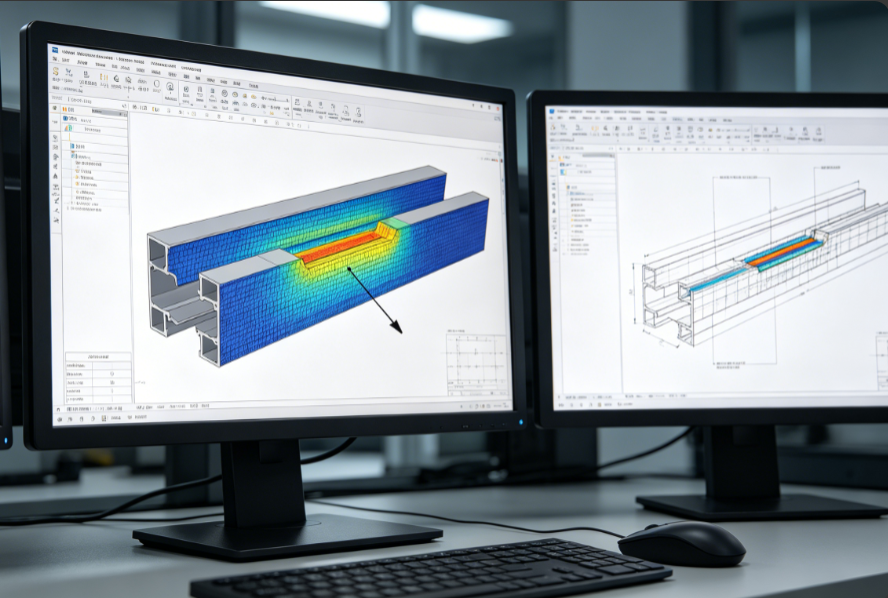
Modern CAD 3D modeling with CAM processing and programming system, synchronized with finite element simulation software, engineers can simulate the profile extrusion molding and force state in the computer. The engineers can simulate the extrusion molding and force condition in the computer, so as to predict the defects of molds and deformation of profiles in advance, reduce the number of repeated revisions and debugging of physical molds, ensure the uniformity and stability of extrusion molding, and significantly reduce the output of scrap at the trial production stage.
Multi-axis CNC Numerical Control Automation
High-speed multi-axis CNC machining center with special aluminum cutting tools to complete the profile precision cutting, milling, drilling, tapping operations, equipment supporting automatic loading and unloading and tool replacement robot arm. The fully automated equipment is capable of 24-hour uninterrupted and stable machining, maintaining micron-level stable tolerance throughout the entire process, significantly increasing the workshop's daily machining capacity and unifying the machining accuracy of the entire batch of products.
AI Machine Learning
The artificial intelligence system collects real-time production data such as extrusion temperature, equipment pressure, extrusion speed, etc., and automatically adjusts the parameters to ensure that the size and performance of each batch of profiles are consistent. The machine learning algorithm completes the predictive maintenance of equipment failures, investigates hidden equipment problems in advance, reduces production line downtime and maintenance time, and optimizes the structural design of profiles to improve manufacturability.
High-pressure Extrusion Equipment and High-performance Wear-resistant Extrusion Molds
The new high-pressure extrusion equipment and porous shunt die with wear-resistant coating technology improve the extrusion speed of profiles, extend the service life of the die, and enable the molding of composite cross-section profiles with more complex structures. Simultaneous optimization of energy consumption of the equipment reduces the power consumption of a single ton of aluminum extrusion production, and improves the surface flatness of profiles, reducing the need for additional finishing processes such as polishing and sanding at a later stage.
Industrial Robot, Friction Stir Welding and Automated Painting
The robotic arm completes the transfer of raw materials, profile assembly, and automatic welding operations, and the friction stir welding realizes weldless high-strength connection, avoiding traditional welding deformation and weld corrosion problems. The automated anodizing and powder coating assembly line uniformly controls the concentration of chemicals and baking temperature, so that the finished products have a uniform and stable surface color and reduce the color difference and rework loss caused by manual spraying.
3D Printing Additive Manufacturing and Extrusion Processes Complement Each Other
3D printing technology is used for rapid trial production of molds, jigs and fixtures, and small composite parts, significantly shortening the development cycle of new product samples and reducing the cost of mold trial and error. Arc Additive Manufacturing WAAM technology with extrusion profiles can create large and complex integrated structures, further reducing the number of parts joining processes and controlling raw material waste output from the source.
Key Factors When Choosing a Custom Aluminum Fabrication Partner
Specialized Technology and Corresponding Industry Project Experience
Priority is given to technical teams that are familiar with various aluminum alloy grades, extrusion processes, secondary finishing processes, and can accurately differentiate between 5052, 6061, 6063 and other alloys in applicable scenarios. We have mature case studies in corresponding industries, such as architectural curtain walls, new energy vehicles, photovoltaic mounts, etc., so that we can quickly understand the industry standards, tolerance requirements and the working conditions of the products.
One-stop Processing Capability
High-quality manufacturers have complete in-house processing lines, including custom mold extrusion, multi-axis CNC machining, bending and friction welding, and a full set of production equipment for finished product assembly. Synchronized with anodizing, powder coating, polishing and other surface treatment workshop, vertically integrated with the whole process business, to avoid the problem of uncontrolled quality and delayed delivery caused by outsourced processing.
Design Optimization Service for Manufacturability
Reliable partners will intervene in the drawing review at the quotation stage and provide professional DFM manufacturability optimization suggestions, adjusting the profile wall thickness, slot structure, and tolerance parameters to reduce processing difficulties. Engineers simplify the complex structure with the extrusion process, promote the integration of parts, and reduce the cost of molds and overall consumption of raw materials without lowering the performance of the product.
Perfect Quality Control System
Priority to hold ISO9001 general quality system certification, the automotive industry supporting manufacturers need to have IATF16949 certification, the certification system represents a standardized quality control process. On-site confirmation of the manufacturer's dimensional testing, mechanical properties, salt spray anticorrosion full set of testing equipment, clear processing tolerances up to ±0.1mm or less, finished product batch-wide retention of testing records traceable.
Production Capacity Scale and Order Delivery Cycle Flexibility
Confirmation of the factory's existing extrusion equipment, processing center capacity, assessment of the simultaneous undertaking of samples of small orders, large quantities of mass production orders production deployment capacity, understanding of the minimum order quantity standards. Communicate the standard delivery cycle for mold development, profile extrusion, and finished product processing, and confirm the manufacturer's support for on-demand, batch-by-batch, just-in-time delivery to meet the company's JIT scheduling needs.
Green and Sustainable Production
The head processing plant uses a large amount of recycled aluminum raw materials, supporting energy-saving extrusion and spraying equipment, and has set up a closed-loop recycling system for aluminum trimmings, which is in line with the requirements of the ESG low-carbon development assessment of the enterprise. The perfect waste recycling mechanism can synchronize the recycling of processing residual materials for customers and realize them to offset the payment for raw materials, which helps the enterprise to reduce the net expenditure on raw material procurement and reduce the pressure on solid waste treatment.
Future Trends in Custom Aluminum Fabrication
Industry 5.0 Intelligent Connected Manufacturing
AI algorithms, IoT sensors, digital twin systems, and collaborative robots open up the entire extrusion production line, realizing real-time automatic regulation of equipment parameters and early warning of failures to reduce downtime. Customers can design the profile cross-section online, and the system provides real-time feedback on extrusion feasibility and cost estimation to realize large-scale personalized customization, taking into account the efficiency of mass production and non-standard customization needs.
Continuous Iteration of Low-carbon Aluminum Alloy Materials
The industry continues to research and develop aluminum-based composite materials and low-carbon alloys with high regeneration content. The new materials take into account both lightweight and ultra-high strength, and are suitable for new energy vehicles and drones in extreme lightweight use scenarios. Specialized alloys are developed for different working conditions; corrosion-resistant alloys are used in marine and chemical environments; high-thermal-conductivity alloys are used for electronic heat dissipation parts; and green power smelting of low-carbon aluminum has become the mainstream raw material choice.
Sustainable Circular Economy Development
The proportion of recycled aluminum in the raw materials of the processing plant has been gradually increased to 80%-100%, and a complete closed-loop recycling system has been set up within the plant. Processing residues are directly returned to the furnace for re-smelting to reduce the consumption of primary aluminum mining. The design phase of profiles follows the design standards of easy disassembly and full recycling, and the carbon footprint is tracked and disclosed throughout the process. The ability to supply low-carbon aluminum materials has become the core competitive advantage of the manufacturer, and meets the requirements of corporate ESG audits.
Continuous Improvement of Profile Functional Integration and Processing Precision
Multi-functional modules such as thermal breaks, sensing lines, and conductive structures have been integrated into the profiles, realizing that a single profile can simultaneously meet the multiple functional requirements of load-bearing, heat dissipation, insulation, and signal transmission. The micro-precision extrusion process has gradually matured, and is used for ultra-thin profiles for small electronic and medical devices. AI topology optimization algorithm designs bionic cross-section, further reducing the weight of aluminum under the same strength.
Conclusion
Customized aluminum processing relies on integrated profile design, full-process supporting processing technology, from material loss, artificial assembly, supply chain management, multi-dimensional reduction of comprehensive costs of enterprise production, suitable for construction, new energy, automotive and other industries lightweight transformation needs. With the continuous iteration of intelligent processing, low-carbon alloy, recycling technology, the application scope of customized aluminum profiles will continue to broaden, and become an indispensable core metal processing solution for manufacturing industry to achieve lean production and green development.
Henan Retop Industrial Co., Ltd. Will Be There Whenever Wherever Whatever You Need

 Key Factors When Choosing a Custom Aluminum Fabrication Partner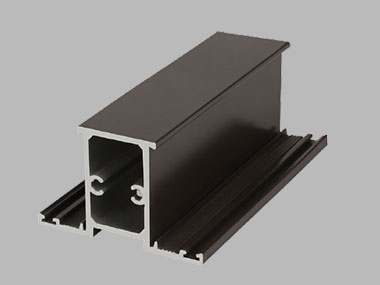
.jpg)