How Custom Aluminum Extrusions Are Used in the Auto Industry
Date:2026-07-07
View: 1362 Point
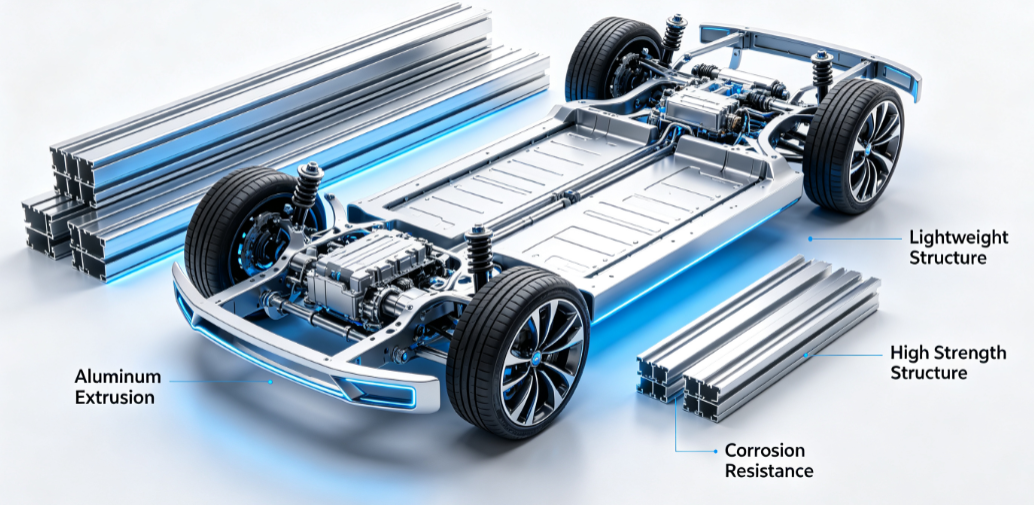
The global automobile industry is comprehensively promoting the upgrading of electrification and low carbonization, and the strict environmental emission regulations of various countries continue to push automobile enterprises to update their vehicle materials and production processes.The weight of traditional steel and environmental protection short board are increasingly prominent, and customized aluminum profiles have become the key materials for automobile manufacturing upgrading by virtue of their core advantages of lightweight, high strength and recyclability.
Why the Automotive Industry Is Turning to Custom Aluminum Extrusions
Iterative Change of Vehicle Materials
In the traditional automobile manufacturing system, steel has long been used as the core raw material of vehicle structure due to its low price, stable structural strength and sufficient supply.It meets the needs of mass production and can meet the basic load-bearing and safety protection standards of traditional fuel vehicles. With the acceleration of global carbon neutralization process, countries have issued strict fuel consumption control and carbon emission policies for six consecutive years.It is difficult for the steel with large self-weight to meet the lightweight demand of vehicles, which has become the main restriction factor for automobile enterprises to save energy and reduce consumption and upgrade vehicle models.
Application of Custom Aluminum Profiles
Vehicle weight is the core factor affecting energy consumption and endurance. Lightweight transformation can effectively reduce fuel consumption and exhaust pollutant emission of fuel vehicles.For new energy vehicles, reasonable weight reduction can directly offset the weight of battery pack and effectively improve the range. Custom aluminum profiles have a high degree of design freedom, and can be customized according to the structural requirements of the model.Standardized integrated components can simplify the production process, reduce assembly costs, and assist vehicle enterprises to quickly iterate new models.
Market Development Trend
The automotive custom aluminum profile market maintains rapid growth, and the industry predicts that it will continue to maintain stable growth in the next decade, with great development potential. Mainstream automobile enterprises and first-class suppliers have laid out composite material systems one after another, relying on customized aluminum profiles to optimize the comprehensive performance of the whole vehicle.
What Are Custom Aluminum Extrusions
Aluminum Extrusion Principle
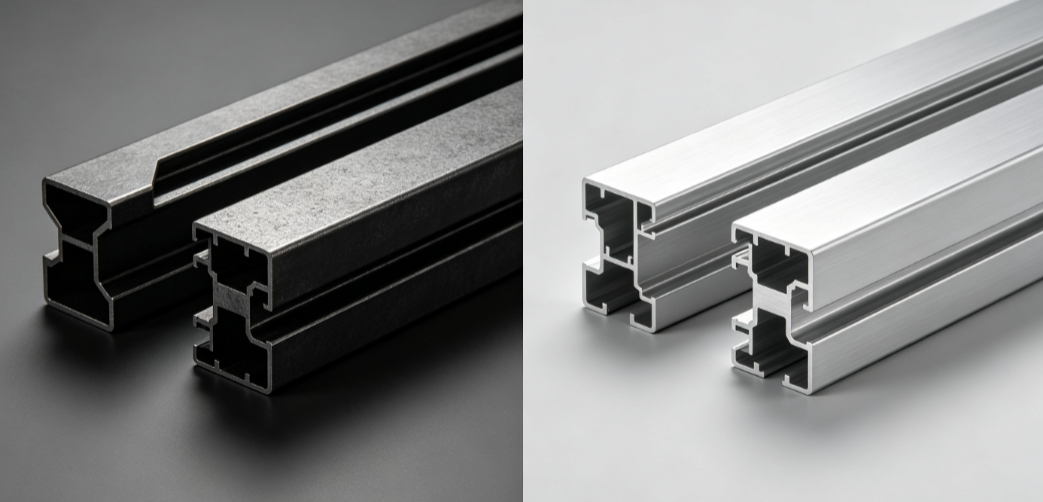
Aluminum profile extrusion is a mature forming process in the industrial field. The core principle is to push the pretreated high-temperature aluminum rod into the customized mold through high-pressure extrusion equipment.Depending on the mold shaping, the long aluminum profiles with regular cross section and uniform size are produced. The principle of this process can be compared with toothpaste extrusion, and the molding accuracy of profiles can be guaranteed by thousands of tons of industrial high pressure.It can stably produce all kinds of precision components and adapt to the production standards of high-precision parts in the automobile industry.
The Difference Between Standard and Custom Aluminum Profiles
In the early stage of customized aluminum profile production, technicians will draw accurate CAD drawings in combination with the use scenes of automobile parts.According to design parameters customized high strength steel mold, ensure profile size, structure fully match product requirements. In the production stage, aluminum rod cutting and preheating softening treatment are completed first, and then extruded by high-pressure equipment.Rapid quenching after forming, locking mechanical properties of profiles, ensuring structural stability.
Custom Aluminum Profile Production Process
The preliminary shaped profile is subjected to a stretch straightening process to eliminate internal stresses generated during production.Effectively avoid profile deformation and bending problems, and ensure the overall size accuracy and flatness of the product. The hardness, strength and structural stability of the profiles are then improved by artificial aging heat treatment.Finally, it is matched with anodizing, spraying, machining and other finishing to complete corrosion prevention and appearance optimization.
Advantages of Custom Aluminum Profiles
Aluminum has excellent thermal conductivity and electrical conductivity, and its thermal conductivity is much better than steel.Can be widely used in automotive cooling components, battery packaging, electronic control shell and other core components to ensure stable heat dissipation of equipment. Custom aluminum profile production loss is very low, the remaining waste can be directly recycled reuse, adapt to industrial mass production mode.The overall production cost is controllable, and the cost-performance advantage of mass production is very obvious.
Why Aluminum Is an Ideal Material for Automotive Components
Crash and Durability Protection
High-end 5000, 6000, 7000 series aluminum alloys with excellent tensile strength and fatigue resistance.In case of vehicle collision, it can efficiently absorb impact energy, buffer impact strength, and comprehensively ensure the safety of drivers and passengers. Aluminum can naturally form a dense oxide protective film on the surface, which can resist corrosion and aging without complex anti-corrosion coating.Effectively reduce post-maintenance costs and significantly extend the service life of body and chassis parts.
Thermal Conductivity and Forming
The heat conduction and heat dissipation performance of aluminum is far superior to that of traditional steel, and the heat exchange efficiency is excellent.It can quickly channel the heat generated by the battery, motor and electronic control of new energy vehicles to ensure the constant temperature and stable operation of core components. Aluminum plasticity and machinability is very strong, can be formed by extrusion, casting, machining and other processes.It can create all kinds of complex special-shaped structures, fully adapting to the diversified and personalized design requirements of modern automobiles.
Low carbon Recyclability and Full Cycle Economy
Aluminum has the characteristics of infinite recycling, and the energy consumption of recycling processing is only about 5% of the original production.By reusing recycled aluminum materials, automobile enterprises can greatly reduce the carbon footprint of vehicle production and help build a green circular production system. Although the procurement cost of aluminum raw materials is higher than that of ordinary steel, the energy consumption and maintenance cost of the whole vehicle life cycle are lower.Comprehensive economic benefits and environmental protection value far exceed traditional steel materials.
Policy and Motorization
The global carbon emission control policy continues to tighten, and automobile enterprises in all regions are facing strict energy consumption and emission assessment.Traditional heavy materials are difficult to adapt to the new regulations, forcing car companies to replace aluminum lightweight materials on a large scale. The rapid rise of new energy automobile industry, battery packaging, lightweight body, thermal management system and other core scenarios.The market demand for high-performance custom aluminum profiles continues to expand, promoting the rapid development of the industry.
Common Automotive Parts Made from Custom Aluminum Extrusions
Body and Chassis Structural Applications
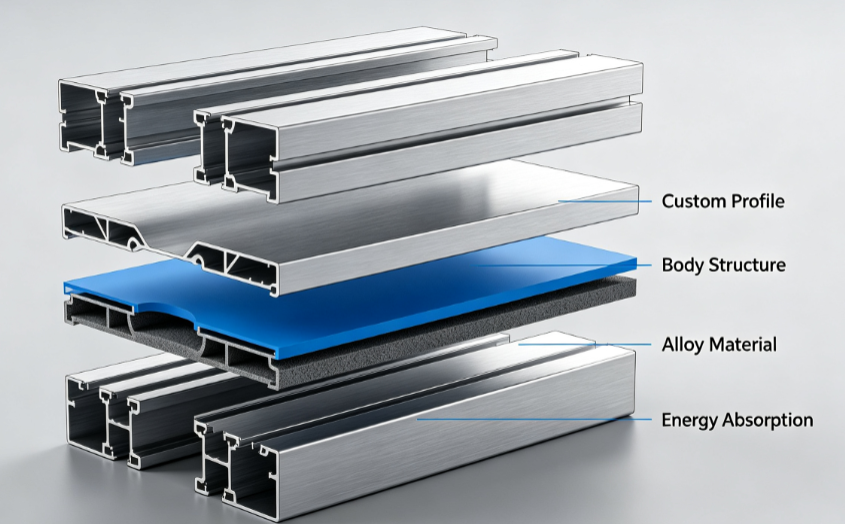
The front and rear bumpers and anti-collision energy absorption boxes of automobiles are mostly made of customized aluminum profiles, which can accurately control the rhythm of collision deformation.It can absorb the huge energy generated by the impact in an orderly manner and buffer the impact force. Excellent energy absorption characteristics can reduce damage to the core structure of the body and reduce vehicle maintenance costs.Avoid severe impact on drivers and passengers to the maximum extent and improve passive driving safety.
Application of Automobile Crash Safety System
Through customized adjustment of profile wall thickness and internal reinforcement structure, it can adapt to various driving scenarios such as front, side and offset collision.Targeted optimization of collision protection effects under different working conditions, adapting to the safety standards of all vehicle models. This kind of customized profile realizes extreme lightweight and comprehensively upgrades the passive safety protection performance of the whole vehicle.Perfect balance between vehicle energy efficiency and safety two core indicators.
Application of Exclusive Components for New Energy Vehicles
Custom aluminum profiles are widely used in roof racks, body trim and other interior and exterior parts.Considering lightweight, aesthetics and durability, it adapts to the appearance design of the whole vehicle and the daily use requirements. Radiator bracket, motor housing and other functional components, relying on aluminum excellent heat dissipation characteristics.It can quickly release the working heat of equipment and ensure the long-term stable operation of automobile core functional components.
Application of Interior and Exterior Decoration and Functional Parts
Automobile suspension control arm, connecting rod and other moving components, the use of customized aluminum profiles can greatly improve fatigue resistance.It can adapt to long-term reciprocating motion conditions and optimize vehicle handling texture and driving stability. Lightweight aluminum seat frames, body pillars and other components can further reduce the weight of the vehicle.On the premise of not affecting safety and comfort, comprehensively improve the comprehensive performance of vehicles.
Emerging Expansion Application Scenarios
Traditional automobile manufacturing is highly dependent on steel materials, but the short board with large self-weight and high energy consumption is very prominent.It is difficult to adapt to the current industry development trend of automobile energy saving and consumption reduction and electric transformation. With the continuous upgrading of aluminum extrusion process and alloy formulation technology, the performance of customized aluminum profiles is continuously optimized.Gradually replace all kinds of steel components and become the core material of modern automobile intelligent manufacturing.
How Custom Extrusions Improve Automotive Manufacturing
Automotive Material Upgrade
Traditional automobile manufacturing is dominated by steel, but the short board with large steel weight is difficult to meet the current demand for energy saving and electric development. Custom extrusion process can form complex shaped, integrated structures at one time, without multiple welding, splicing, grinding.Greatly streamline parts production processes and improve production and processing efficiency.
Volume and Cost Optimization Value
Custom aluminum profiles are highly compatible and can be used with steel and composite materials to create a multi-material composite body architecture.Give consideration to structural strength, lightweight and cost balance, adapt to high-end vehicle building concept. Flexible customized structural design, can quickly adapt to model iteration and structural upgrade.Effectively shorten the R & D cycle of new vehicles and improve the response speed of automobile enterprises to market demand.
Innovative Development of Automobile Architecture
The strength, toughness, formability and corrosion resistance of different series aluminum alloys vary greatly.Alloy selection directly determines the structural strength, service life and safety performance of automobile parts. Accurate matching of aluminum alloy grades can effectively avoid molding defects, corrosion aging, insufficient strength and other problems.All-round guarantee the long-term stable and safe operation of the whole vehicle.
Choosing the Right Aluminum Alloy for Automotive Extrusions
Series and Characteristics of Aluminum Alloys
6000 Series
6000 series Al-Mg-Si alloy is the core material of customized extrusion profile for automobile, and its mechanical properties can be strengthened by heat treatment.Excellent extrudability, structural strength and surface texture, suitable for most automotive parts. Among them, 6063 focuses on appearance and extrusion effect, mostly used for body decoration and appearance profile;6061 has higher strength and adapts to ordinary structural parts; 6005A is mainly high strength, mostly used for chassis and body load-bearing structure.
5000 Series
5000 series aluminum alloy has excellent corrosion resistance and welding performance, suitable for humidity, salt fog, muddy water complex driving conditions.It is very suitable for automobile chassis, body bottom protection and other exposed easily corroded components. The series alloy has good forming stability, strong post-processing adaptability, long-term resistance to outdoor environmental corrosion, and effectively prolongs the overall service life of automobile chassis parts.
2000 and 7000 Series
2000 series and 7000 series aluminum alloys have ultra-high tensile strength and load-bearing capacity, and their mechanical properties far exceed those of conventional aluminum profiles.It can meet the requirements of high-end models such as high-strength load-bearing and anti-collision protection. Such alloys are difficult to extrude, high in production cost and strict in mass production process.At present, it is only applied to special structural parts of high-end models and performance vehicles in a small range.
Core Considerations for Aluminum Profile Selection
Matching Principle of Mechanical Properties
The selection is mainly based on the load-bearing, anti-collision and anti-fatigue requirements of the parts, matching the aluminum alloy with the corresponding strength grade.Ensure the structural rigidity of the vehicle body, the impact energy absorption effect and the driving safety of the whole vehicle meet the standards. At the same time, the balance between toughness and hardness of materials is considered, and the brittle fracture problem of high hardness materials is avoided.Let the profile achieve optimal safety protection performance under the premise of lightweight.
Extrusion Process Adaptability
Most customized profiles are hollow, multi-cavity, thin-walled and complex structures, which require high extrusion performance of alloys.It is necessary to select a suitable alloy with good fluidity, stable molding and difficult cracking. High quality molding performance can greatly reduce the scrap rate of mass production and secondary processing.Effectively simplify the production process and improve the mass production efficiency and accuracy of vehicle parts.
Corrosion Resistance and Durability Performance Requirements
Automobile long-term exposure to high temperature, rain, road salt and other corrosive environment, profiles are easy to aging corrosion.The aluminum alloy selected must have stable natural corrosion resistance. Good corrosion resistance can reduce the cost of later anti-corrosion coating and maintenance.Greatly extend the service life of body, chassis and battery structure profiles.
Adaptability Between Subsequent Processing and Assembly
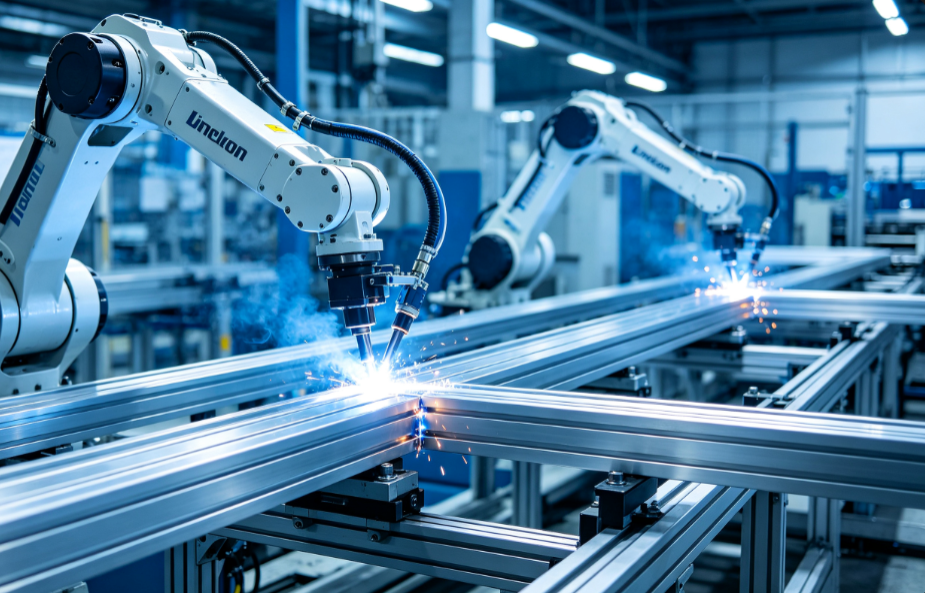
After leaving the factory, automobile aluminum profiles need to go through welding, bonding, spraying, machining and other multi-channel processes.Alloy materials need to adapt to a variety of post-processing technology, not easy to deform, delamination. Stable processing adaptability can ensure the assembly accuracy and appearance quality of parts.Effectively reduce the comprehensive processing cost of vehicle production.
Cost and Low Carbon Adaptation Standards
Alloy selection should be combined with vehicle positioning and mass production scale, balancing material performance and procurement cost.On the premise of meeting the use standard, the alloy grade with high cost performance should be optimized. At the same time, recyclable, low-carbon formula aluminum alloy is preferred, which is in line with the development trend of circular economy in the automobile industry.Bicycle companies complete environmental protection and ESG assessment indicators.
Design Considerations for Custom Automotive Aluminum Profiles
New Technology Upgrades Profile Design
Finite element simulation, three-dimensional modeling and other digital technologies can simulate the stress, heat dissipation and deformation of profiles in advance.Check design defects in advance, greatly reduce R & D trial and error costs, and shorten new product development cycle. High-precision machining and continuous iteration of compound extrusion processes enable thin-walled, special-shaped, multi-cavity complex integrated profiles to be mass-produced.Greatly improve the practicality and large-scale landing ability of customized profiles.
Industry Development of Custom Aluminum Profile Design
The competition for new energy vehicles is becoming increasingly fierce, and extreme lightweight is the core upgrading direction.Custom profiles allow precise weight reduction while ensuring strict body structural safety and rigidity standards. The sensors, cameras and other equipment of intelligent driving system have extremely high requirements for the accuracy of installation base.Customized aluminum profiles can meet the requirements of high precision tolerances and ensure the stable operation of intelligent equipment.
Automotive Aluminum Profile Custom Design
Customized profiles can integrate multiple functions such as heat dissipation, fixation, sealing, and limiting.The multi-component combination structure is integrated into one, the body structure is simplified, and the assembly failure rate is reduced. Aluminum can follow the characteristics of low carbon ring, with customized precision molding process.It can effectively reduce the carbon emission of vehicle production, and assist vehicle enterprises to achieve the strategic goal of carbon neutralization.
Key Design Points of Custom Profiles
Profile design needs to adapt to steel and aluminum mixing, bonding, welding and other multi-material connection process.Ensure the assembly accuracy and connection stability of multi-material body, and eliminate loosening and deformation problems. At the same time, it takes into account the flatness of profile appearance and the adaptability of surface treatment, and can easily realize anodizing, spraying and other processes.Meet the dual needs of vehicle appearance and anti-corrosion durability.
Future Trends of Custom Aluminum Extrusions in the Automotive Industry
Product and Process Technology Upgrade Trends
In the future, aluminum profile production will develop in the direction of large-scale, integration and integration, and large size hollow integral profiles will be gradually popularized.simplify that complex structure of the electric vehicle body and the battery pack and greatly reduce the assembly process. New high-strength and high-toughness aluminum alloy materials continue to be developed and iterated, and the comprehensive mechanical properties are comprehensively improved.It can further strengthen the collision resistance and structural stability of the whole vehicle and meet the requirements of high-end models.
Low-carbon Sustainable Development Trends
The closed-loop recycling system of aluminum materials continues to improve, and the recycling, re-refining and recycling technologies of waste aluminum materials become more and more mature.The utilization rate of recycled aluminum profiles in automobile enterprises continued to increase, effectively reducing carbon emissions at the production end. Low energy consumption green extrusion process gradually replaces traditional production mode, reducing production energy consumption and pollutant emission from the source.All-round assistance to the automobile industry to achieve carbon neutral green development goals.
Intelligent Scene Adaptation Trend
With the popularization of intelligent driving and vehicle-mounted electronic equipment, automobile functions become more and more integrated.Customized aluminum profiles are gradually upgraded to multifunctional composite structures, integrating multiple functions such as sensor installation, heat dissipation, and fixation. Modular profile design has become the mainstream of the industry, and standardized modules can adapt to multiple models and multiple production platforms.Effectively reduce the R & D and mass production costs of automobile enterprises, and improve the iteration efficiency of vehicle models.
Conclusion
With multiple advantages such as lightweight, high strength, easy processing and recyclability, customized aluminum profiles are deeply adapted to the needs of automobile electrification and low-carbon transformation, and are widely used in core scenarios such as body, chassis, battery and safety system.As alloy technology and extrusion processes continue to upgrade, product performance and compatibility will continue to be optimized.In the future, customized aluminum profiles will become the core material of intelligent automobile manufacturing, helping the industry to achieve multiple goals of energy saving, efficiency improvement, safety upgrading and green development.
Henan Retop Industrial Co., Ltd. Will Be There Whenever Wherever Whatever You Need

 Application of Interior and Exterior Decoration and Functional Parts