Aluminum hardening is a key technology to enhance the value of its industrial applications, covering the principle, process, testing and other core aspects. This article focuses on the core of age hardening, disassembles the key points of practical operation, and helps to accurately master the strengthening skills of aluminum profiles.
What Does “Hardening Aluminum” Mean?
Aluminum hardening, also known as age hardening or precipitation hardening, is a core process to enhance the strength and hardness of aluminum and aluminum alloys through heat treatment. The core principle is that aluminum is heated to a specific temperature so that the alloying elements are fully dissolved and then rapidly cooled to form a supersaturated solid solution. This unstable microstructure leads to the slow precipitation of tiny precipitated phase particles, which effectively impede the dislocation movement within the metal, thus significantly enhancing the mechanical properties of the profile without changing its shape. This process is widely used in modern industry, especially in scenarios that require a balance between strength and lightness. Unlike other hardening methods, age hardening can accurately regulate the properties of aluminum and has high dimensional stability during the process, making it a key technology support for aerospace, automotive and other high-end fields.
Key Benefits of Age Hardening Aluminum
Age-hardening brings a number of performance leaps to aluminum profiles, giving them irreplaceable advantages in a wide range of application scenarios. Firstly, the strength and hardness of aluminum profiles are significantly improved. Through the reinforcing effect of precipitated phase particles, the tensile strength and hardness of aluminum profiles can reach several times that of the untreated state, while maintaining a low density, thus realizing the core demand of “light and strong”. Optimized grain structure is another highlight, strict control of process parameters can form a uniform distribution of fine precipitated phase, so that the mechanical properties of aluminum is more stable, to avoid failure caused by local weak points. In terms of wear resistance and corrosion resistance, the hardened aluminum surface hardness is enhanced to better resist friction loss, and some of the alloys are treated to enhance corrosion resistance, which is particularly suitable for harsh environments such as marine and outdoor. Dimensional stability is also a prominent advantage of age hardening, heat treatment process deformation is very small, can meet the dimensional accuracy requirements of precision parts. In addition, by adjusting the aging temperature and time, the mechanical properties of aluminum can be flexibly customized to find the best balance between strength, toughness, ductility, and compared to other strengthening processes, age hardening is more cost-effective and suitable for large-scale industrial production.
Different Types of Aluminum HeatTreatment
Annealing
Annealing is one of the most basic processes in aluminum heat treatment, and is used to eliminate work-hardening that occurs during cold working, forging, and other processes. The process consists of heating the aluminum to a temperature range of 570°F to 770°F, holding for 30 minutes to 3 hours depending on the size of the profile and alloy composition, and then cooling slowly to room temperature. This process restores the slip surfaces within the aluminum, releases accumulated internal stresses, and re-stabilizes the grain structure. The ductility of annealed aluminum is significantly increased, making it easier to perform subsequent bending, stamping, and other forming processes, as well as correcting warpage distortions that occur during casting and preventing cracking during use. Both heat-treatable and non-heat-treatable alloys can be annealed to improve processability.
Solution Heat Treatment Process
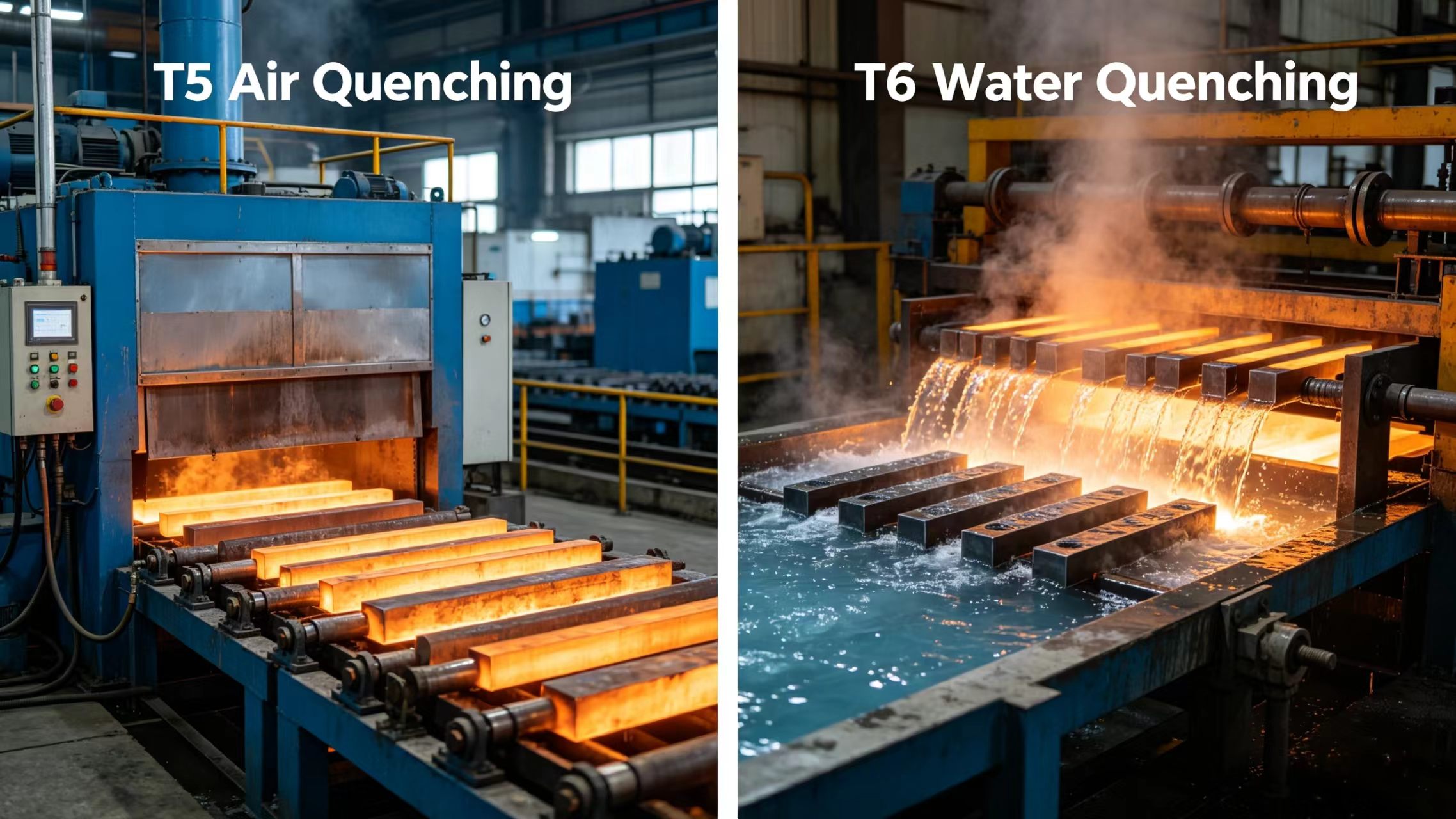
Solution heat treatment is a critical step prior to age hardening, and its core purpose is to fully dissolve the alloying elements in the aluminum to form a homogeneous single-phase solid solution. The process involves heating the aluminum to 825°F-1050°F (slightly below the melting point of the alloy), with holding time adjusted according to the size of the part, ranging from about 10 minutes for small parts to up to 12 hours for large parts. After heating, the aluminum is quickly quenched, usually in water or a polymer solution. Water quenching is fast and prevents the early precipitation of alloying elements to the maximum extent possible, ensuring a supersaturated solid solution; while polymer quenching is more suitable for complex shapes or thin-walled profiles, reducing the internal stresses generated during the cooling process and lowering the risk of cracking and deformation. After solid solution treatment, the aluminum is in a soft state, which facilitates subsequent machining and prepares it for the final age-hardening.
Homogenizing
Homogenizing is mainly used for casting aluminum profiles to solve the problem of compositional segregation that occurs during the casting process. During casting cooling, the outer layer of aluminum solidifies first to form pure aluminum grains, while alloying elements with higher melting points will gather in the center, resulting in uneven internal and external properties of the profile and affecting subsequent processing and use. Homogenization treatment is performed by heating the cast aluminum to 900°F-1000°F, holding it for a period of time to allow the alloying elements to fully diffuse and achieve a uniform distribution of components, and then slowly cooling it to fix this state. After treatment, the overall mechanical properties of the cast aluminum tend to be consistent, making it less difficult to process, and effectively preventing molding failures or structural failures during use due to local compositional differences.
Aging
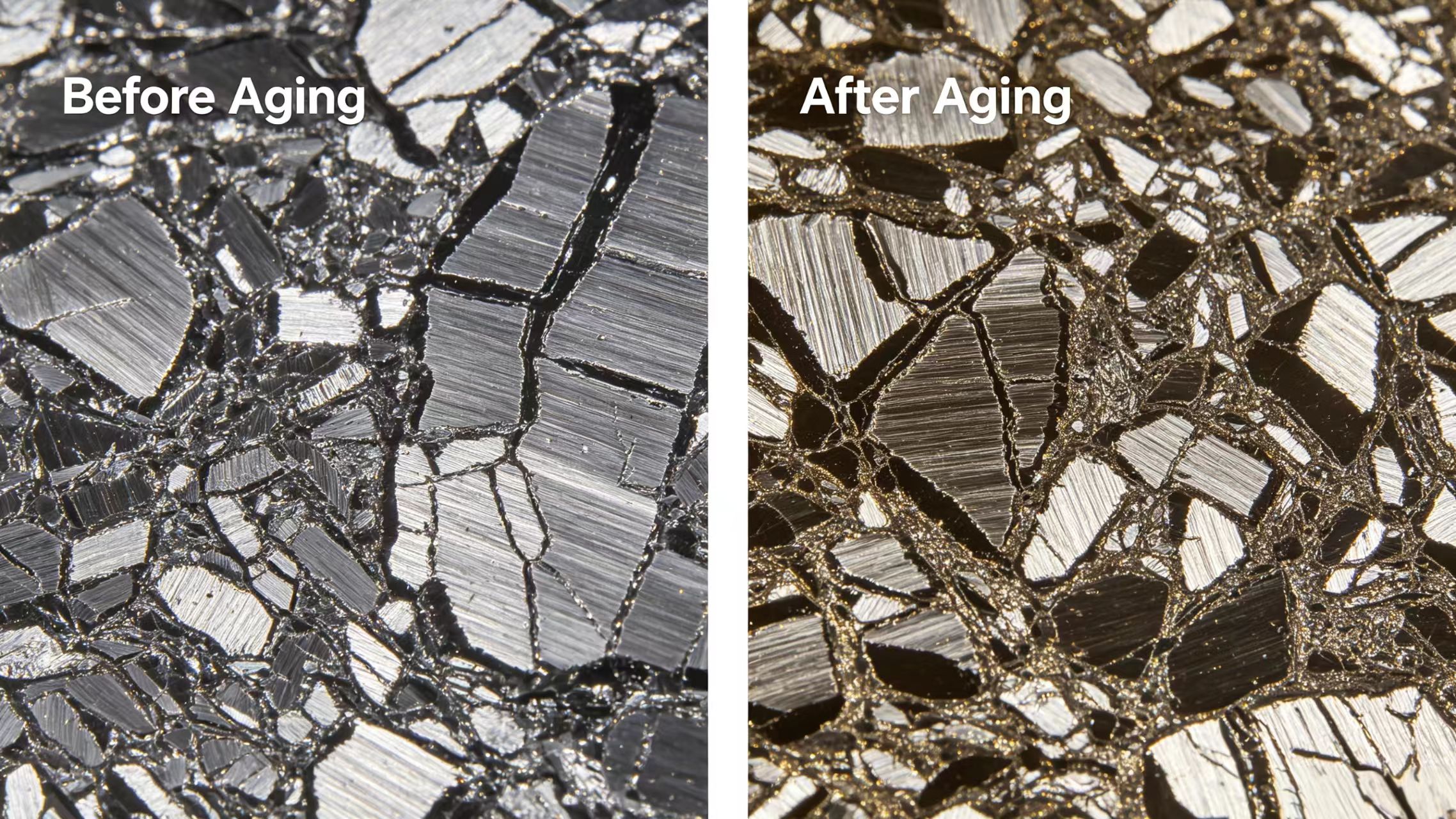
Aging treatment is the core link of aluminum hardening, divided into natural aging and artificial aging two ways, the essence is to let the supersaturated solid solution after solid solution treatment precipitation of uniform fine precipitation phase particles. Natural aging does not require additional heating, the quenched aluminum can be placed in a room temperature environment, most of the hardening effect is completed within 24 hours, fully stabilized can significantly improve the strength and hardness. This method is suitable for scenarios that do not require a high production cycle and relatively mild performance requirements, but it should be noted that the molding process should be carried out as soon as possible after the aging process is completed to avoid excessive hardness affecting the operation. Artificial aging (also known as precipitation hardening) accelerates precipitated phase precipitation by active heating, heating the aluminum to 240°F-460°F, holding for 6-24 hours, and then cooling. This method is more efficient and precise in controlling properties, allowing the aluminum to achieve higher strength levels for high-end applications where hardness is critical. Artificial aging parameters vary considerably from alloy to alloy and require strict temperature and time profiles based on the specific material.
Understanding Aluminum Temper Designations and Common Types
Aluminum extrusions have a hyphenated status code attached to the base alloy number, e.g., “-T73” in 7075-T73 is the status code. Aluminum alloys have four basic condition designations, -F (machined), -O (annealed), -H (strain-hardened), and -T (heat-treated). A fifth designation, - W, is used to describe the quenched condition after solution heat treatment and before artificial aging or room temperature aging. The following are specific definitions for each type of condition: H111: Applies to products with strain hardening below the requirements of the controlled H11 condition. H112: Applies to products that have naturally acquired a certain condition during molding (no special control of strain hardening or heat treatment), but have defined mechanical property limits. The following H-series condition codes are used exclusively for deformed aluminum alloys with a nominal magnesium content of more than 4%: H311: For products with strain hardening below the requirements of the controlled H31 condition. T1: Naturally aged to a basically stable state after cooling by a high temperature forming process. T2: Annealed condition (applicable to cast products only). T3: Cold working after solution heat treatment, applicable to products where the strength is enhanced by cold working, or where the role of cold working in the leveling and straightening process has been included in the consideration of mechanical property limits. T4: solid solution heat treatment after natural aging to a basically stable state, applicable to solid solution heat treatment without cold working, or cold working in the process of leveling, straightening, the role of cold working is not included in the mechanical properties limit value of the consideration of the product. T5: After cooling by high temperature molding process, artificial aging treatment. T6: Solution heat treatment followed by artificial aging, mechanical property limits are not affected by cold working, most of the alloys in the - W state and - T4 state can reach - T6 state after artificial aging. T7: Solution heat treatment followed by stabilization, suitable for products that have been stabilized beyond the point of maximum strength to achieve dimensional growth control and residual stress control. T8: Solid solution heat treatment followed by cold working and then artificial aging, for products where strength has been increased by cold working or where the role of cold working in the leveling and straightening process has been taken into account in the consideration of mechanical property limits.
Factors That Affect Aluminum Hardness
Alloying Element Content
Alloying elements are the basic factors that determine the hardness of aluminum profiles, and the ratio of different elements directly affects the hardening effect. For example, 7075 aluminum alloy contains 5.1%-6.1% zinc, 1.2%-2.0% copper and 2.1%-2.9% magnesium, the hardness is significantly higher than that of 6061 aluminum alloy, while 6061 aluminum alloy with magnesium (1.0%-1.5%) and silicon (0.4%-0.8%) as the main alloying elements, the hardness is relatively low, but with better weldability and processability. Zinc, copper and magnesium are the core elements to enhance the hardness of aluminum, and their content needs to be precisely regulated according to the application requirements: a high content of alloying elements is suitable for the pursuit of the ultimate strength of the scenario, while a balanced ratio can take into account both the strength and the processing performance, to meet the needs of the general industry.
Heat Treatment Parameters
Heat treatment process is the core means to regulate the hardness of aluminum profiles, and the deviation of each parameter will directly affect the final hardness. The temperature and holding time of solid solution treatment need to ensure that the alloying elements are completely dissolved, insufficient temperature or holding time is too short will lead to insufficient dissolution, the subsequent hardening effect of aging greatly reduced; quenching speed determines the stability of the supersaturated solid solution, slow cooling will make the alloying elements precipitated in advance, reducing the hardening potential. Artificial aging in the temperature is too high or too long will reduce the hardness; temperature is too low or time is not enough hardness is not up to standard. The temperature and humidity of the natural aging environment will also affect the hardening rate and final hardness, and the storage environment needs to be controlled.
Manufacturing and finished state
The manufacturing process and final state of aluminum affect the hardness. Aluminum produced by hot pressing or casting is usually lower in hardness; cold worked aluminum is harder through work hardening. The surface condition of the finished product affects the hardness test results, e.g. oxidized layers, scratches, and oil can cause distortion of the test, whereas a smooth surface is more reflective of the true hardness. The sequence of subsequent machining is also critical. Extensive machining after age-hardening may result in a loss of hardness due to internal stress release.
Common Mistakes When Hardening Aluminum
Deformation and Hardening Cracking Problems
Hardening of aluminum profiles often results in distortion and cracking due to uneven cooling and internal stresses. Sharp internal corners, cross-section thickness variations, thin walls and asymmetric shapes are prone to stress concentrations and increase the risk of quench cracking. It can be solved from the design and process aspects. The design should be rounded corners to avoid sharp corners and sharp thickness changes; process needs to be selected according to the profile quenching medium, complex or thin-walled parts can be selected polymer solution rather than pure water. At the same time, the use of jigs and fixtures to control the placement and cooling direction can reduce deformation.
Insufficient Hardness (under-ageing) and Over-ageing Problems
Under-hardening is due to under-ageing, which can result from too low an aging temperature, insufficient holding time, or inadequate solution treatment, resulting in too few precipitable alloying elements. In addition, if the quench is left too long before artificial aging, the natural aging will occur earlier, weakening the strengthening effect, which may also result in substandard hardness. Over-aging is due to the temperature is too high or the time is too long, resulting in precipitated phase particles grow up, the spacing increases, the strengthening effect is weakened, so that the hardness of the aluminum material decreases, toughness rises. The key to determine the under or over-ageing in the hardness consistency: the whole batch of low hardness is a parameter problem, local unevenness is the uneven distribution of furnace temperature or parts due to too dense. To avoid such problems need to strictly calibrate the heat treatment equipment to ensure that the temperature control accuracy within the range of ±5-10 ° C; according to the alloy grade and the size of the parts to develop a precise aging curve, to avoid blindly adjusting the parameters; quenched parts should be transferred to artificial aging process as soon as possible, generally should not be more than 4 hours, to prevent the natural aging excess.
Precautions for Secondary Heat Treatment
When the hardening effect of aluminum is not up to standard, in some cases can be remedied by secondary heat treatment, but need to follow strict specifications. Secondary heat treatment usually requires re-solution treatment and aging, but if the aluminum has been through several heat treatments, it may lead to coarse grain size, which affects the overall performance. Secondary solid solution temperature should be slightly lower than the first time, to avoid overheating lead to grain growth or grain boundary melting; quenching need to pay more attention to cooling uniformity, because the initial hardening of the internal stress is complex and easy to secondary cracking. After the second heat treatment, the hardness and performance should be re-tested to ensure compliance with the requirements.
How to Test Aluminum Hardness
Rockwell Hardness Testing
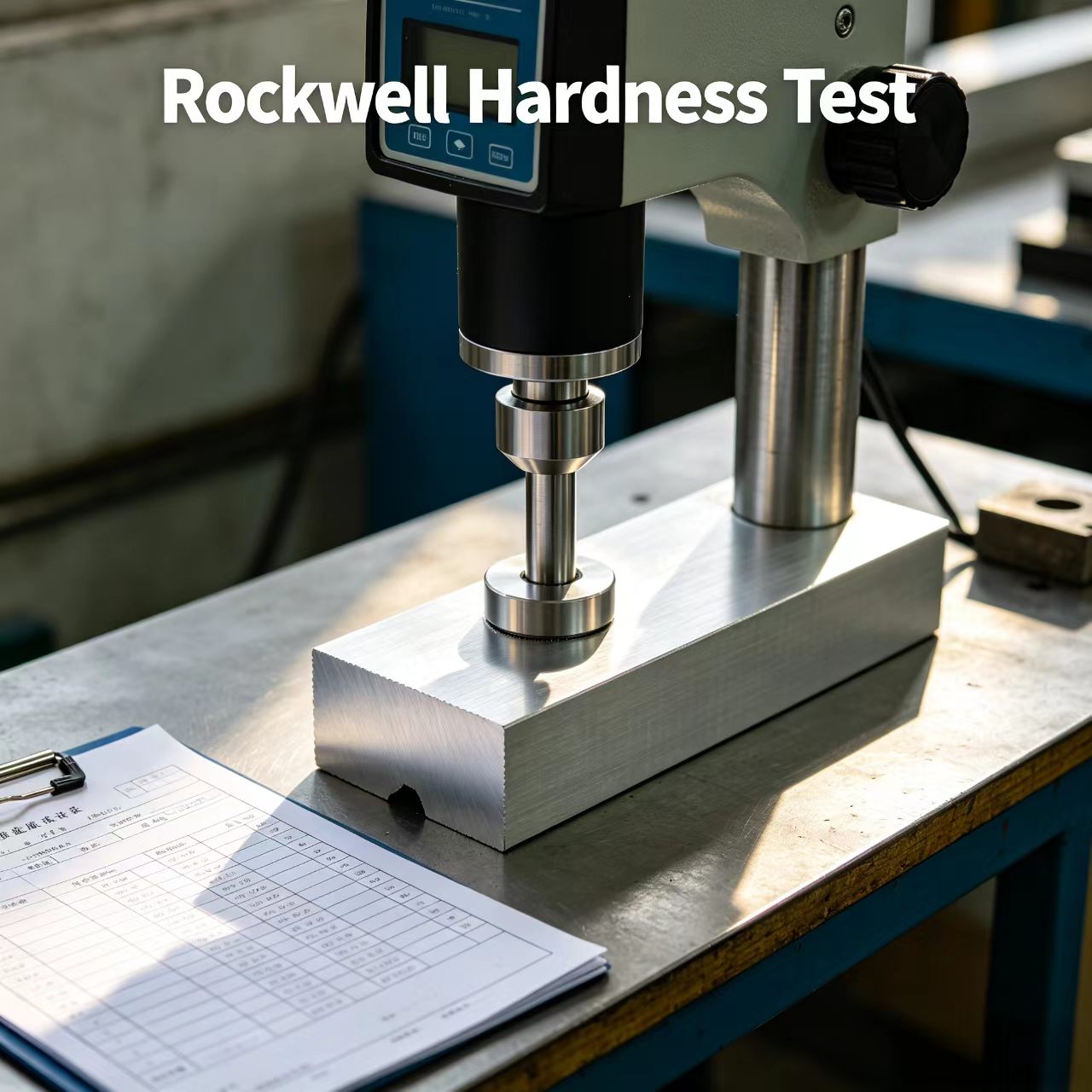
Rockwell hardness test is easy to operate and efficient in aluminum hardness testing, suitable for batch quality control. The hardness is determined by the depth of indentation of the indenter under load, and the hardness value is calculated by calculating the depth difference after preload and main load. Aluminum profile hardness test mostly adopts HRB scale, using 100kgf load and steel ball indenter, suitable for low hardness aluminum; higher hardness reinforced aluminum can choose other Rockwell scale. This method is fast, direct reading, small indentation, and little damage to the profile.
Brinell Hardness Test
Brinell hardness test adopts large diameter steel ball and large load, suitable for detecting coarse grain casting aluminum profiles or large aluminum parts. It forms a large indentation on the surface, averages out the differences in material composition and grain size, and obtains a representative hardness value. The test needs to measure the diameter of the indentation and calculate the HB value, which can avoid the misjudgment of local hard and soft spots and reflect the overall hardness, but the indentation is large and not suitable for precision finished products.
Vickers Hardness Test
Vickers hardness test is versatile and can measure various hardness of aluminum profiles. It uses a diamond tetragonal indenter, applies a variable load, and calculates the hardness according to the diagonal of the indentation. Wide load range, microscopic and macroscopic testing, able to measure coatings, small areas and overall hardness, high precision, suitable for scientific research and other demanding scenarios, but requires specialized personnel to operate and analyze.
Knoop Hardness Test
Knoop hardness testing uses a diamond-shaped indenter to form a thin indentation, and calculates the hardness by measuring the long diagonal. Its 10-1000 gf load is suitable for testing brittle materials, thin aluminum, coatings and near-edge areas. The shallow, long indentation prevents cracking of the specimen and is especially suitable for thin or surface-treated aluminum. For anisotropic aluminum, adjusting the test direction reflects hardness differences and provides more comprehensive performance data.
Richter Hardness Test
The Richter hardness test is a portable, on-site inspection method that evaluates the hardness of aluminum by impacting a tungsten carbide ball against the surface and measuring the rate of rebound, with higher rebound rates resulting in greater hardness. The Richter hardness test is flexible, fast, and not limited by specimens, making it suitable for sampling large workpieces. However, the accuracy is low and susceptible to surface conditions, so it is usually used for initial screening, while critical parts still need to be combined with other accurate methods.
Shore Hardness Test
Shore hardness testing is mostly used for testing elastomers and soft plastics, and is less commonly used in aluminum profile testing, but can be used to assess the surface hardness of soft aluminum alloys or aluminum matrix composites. The principle is to measure the depth of indentation by means of a spring-loaded indenter, with different scales corresponding to different hardness ranges, e.g. Shore A for soft rubbers and Shore D for hard plastics. In aluminum testing, the Shore hardness test is only applicable to specific scenarios. If you need to assess the hardness of soft coatings on the surface of aluminum or test pure aluminum profiles with very low hardness, you need to pay attention to choosing the right scale to avoid distortion of the test results.
Conclusion
Hardening of aluminum profiles requires a balance between process parameters, alloy properties and testing standards to avoid common misconceptions. The scientific use of heat treatment and testing methods can maximize the performance of aluminum and meet the high-end needs of many fields.
Henan Retop Industrial Co., Ltd. Will Be There Whenever Wherever Whatever You Need

 Aging
Aging