Why are angle connectors preferred for joining industrial aluminum profiles
Date:2026-07-02
View: 1888 Point
With its outstanding advantages of lightweight, high strength, corrosion resistance and recyclability, industrial aluminum profiles are widely used in industrial automation equipment, assembly line workstations, commercial display racks and other industrial scenarios.As the core connection parts of modular assembly of aluminum profiles, angle parts are the key components to ensure accurate splicing and stable overall structure of profiles
What Are Angle Connectors for Aluminum Profiles
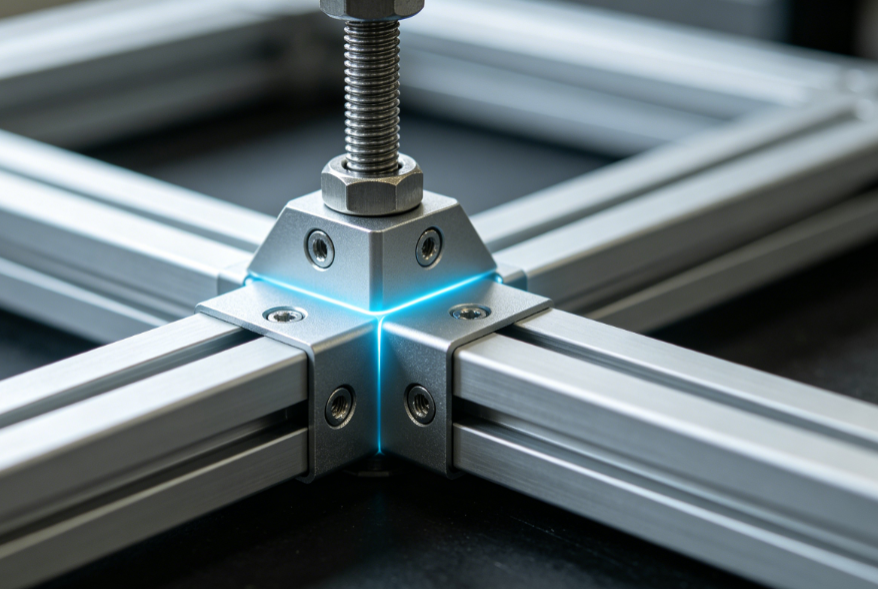
Aluminum angle fitting is specially adapted to T-groove, V-groove industrial aluminum fastening accessories, the main multi-angle precision splicing, 90° right angle splicing is the most commonly used form of industrial assembly.At the same time, it can also meet the non-standard assembly requirements of 45°, 135° fixed angle and arbitrary adjustable angle. The biggest core advantage of this accessory is that it can quickly build a stable and regular modular profile frame without complicated precision machining processes such as welding and milling.It greatly simplifies the assembly process of aluminum profiles and can easily adapt to various assembly scenarios of simple tooling and complex industrial equipment.
Why Are Angle Connectors Widely Used
Structural Bearing Performance
The structural weakness of aluminum profile frame is mostly concentrated in the joint of profile splicing. It is difficult for ordinary single fastener to resist equipment vibration and external bending, and it is easy to cause structural loosening failure.The angle pieces greatly improve the rigidity of the splice joints and the overall structural stability by means of multi-surface joint connection. Heavy-duty, reinforced angle braced angle pieces are specially adapted to high-load industrial conditions such as mechanical equipment, conveying lines, safety protection frames, etc. The overall splicing strength is comparable to traditional welding processes.At the same time, the core characteristics of mechanical connection can be disassembled and adjusted, and the practicability is stronger.
Modular Flexible Properties
Corner fitting perfectly fits the modular assembly system of aluminum profiles. Most standard models do not require complex secondary processing. They can be installed directly into profile slots with special fasteners.No need for professional technicians and large construction equipment, on-site rapid construction, assembly threshold is very low. The profile structure of corner piece splicing can be disassembled, transformed and expanded at will, easily adapting to production requirements such as product iteration upgrade and production line layout adjustment.With multi-specification angle style, you can flexibly build various complex and irregular structures, and the adaptability is far superior to traditional connection methods.
Construction and Cost Advantages
Compared with traditional profile connection processes such as welding and riveting, corner fitting assembly does not require professional certified operators, and there is no high temperature operation throughout the process.Completely avoid the welding high temperature caused by profile deformation, material damage problems, while eliminating grinding, paint repair, calibration and other cumbersome follow-up procedures. Standardized corner parts are highly versatile and can be adapted to 2020, 3030, 4040 and other multi-series aluminum profiles, effectively reducing the inventory types and procurement costs of accessories.The construction cycle was greatly shortened, reducing the construction period from several days to several hours, significantly reducing labor and material consumption.
Industry-wide Adaptability
The adaptation scene of aluminum profile angle parts covers the whole industrial field. Whether it is automation equipment frame, new energy photovoltaic bracket, electronic equipment shell or building modular partition, stable and accurate splicing installation can be realized through angle parts.Adapts to most industrial construction needs. With the comprehensive popularization of intelligent manufacturing and lean production concepts, modular and reusable industrial accessories have become the mainstream of the industry.Repeatable, green and environmentally friendly aluminum corner fittings have become the core preferred accessories for modular construction of modern chemical plants and intelligent equipment.
Safe, Durable and Environmentally Friendly
The aluminum profile formed by corner pieces has strong structural stability, which can effectively resist vibration interference caused by continuous operation of equipment, and greatly reduce the safety risk of structural loosening, skew and even collapse.It provides reliable guarantee for industrial safety production and effectively reduces the hidden danger of equipment failure and shutdown. Corners are corrosion resistant, anti-aging, long-term use without frequent maintenance, operation and maintenance costs are extremely low.At the same time, the accessories can be repeatedly disassembled and recycled, effectively reducing the generation of industrial waste, fully conforming to the industrial circular economy and green and low-carbon production development concept.
Applications of Angle Connectors in Industrial Projects
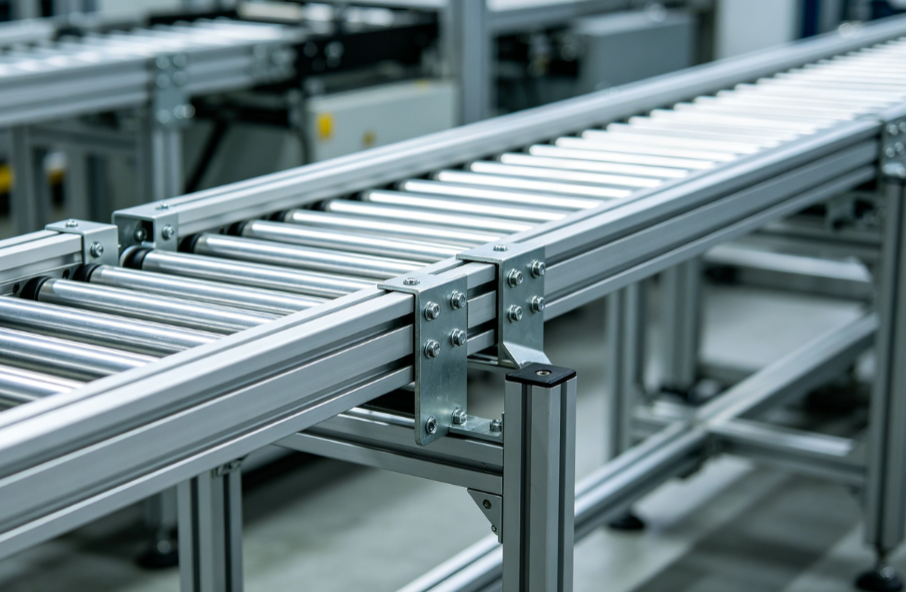
Equipment frame and safety protection field: angle pieces are mainly used to build various equipment racks, safety fences, equipment shields, and the overall structure is stable and reliable.At the same time, it is convenient to disassemble and assemble, easy to repair and maintain, and fully complies with the standardized specifications for industrial safety production. Production line and conveying equipment field:angle pieces can be built modular conveying rack, multi-functional workstation operation platform, flexible and adjustable structure.It can freely adjust the layout according to the requirements of production process optimization and capacity expansion, and adapt to the iterative upgrading requirements of production lines. Automation and robotics field: high-precision industrial angle parts can ensure the accuracy and flatness of the robot arm frame and sensor mounting bracket.It meets the strict working conditions of high-speed operation, accurate positioning and repeated operation of automatic equipment. Tooling station equipment field:modular workbench, test bench, tool car are used angle splicing molding, lightweight structure and sufficient bearing capacity.The height and overall structure of the equipment can be adjusted according to needs, and the work position layout can be optimized to effectively improve the comfort and efficiency of workers. Clean workshop field:corrosion resistant, easy to clean special corner pieces, suitable for medicine, electronics, semiconductors and other dust-free production industries.It can quickly set up clean shed, air shower cover, equipment closed frame, easily meet the dust-free clean production standards. Storage storage field:corner splicing aluminum shelves, material storage shelves light weight, strong bearing, good structural stability.Support vertical and horizontal free expansion, flexible adjustment according to warehouse inventory scale, adapt to diversified storage needs. Commercial field of exhibitions: Corner pieces have outstanding advantages of convenient disassembly and assembly, reusability, and light transportation, and are suitable for the rapid construction of exhibition booths and industrial display panels.It can greatly reduce the construction cost and later operation and maintenance cost of commercial display. New energy infrastructure field: outdoor corrosion resistance, aging resistance, stable structure, suitable for solar photovoltaic brackets, wind power supporting equipment frame construction.It can adapt to outdoor high and low temperature, wind and rain erosion and other complex and harsh conditions, and has a long service life.
Angle Connectors vs Other Aluminum Profile Joining Methods
Mainstream Aluminum Profile Connection Mode
Industrial aluminum profile splicing has a variety of mainstream construction processes, in addition to the commonly used corner connection, but also includes embedded hidden connection, direct bolt fastening, welding, custom three-dimensional connection and other ways.Different technologies adapt to different construction scenarios and functional requirements respectively. There are obvious differences in structural strength, construction difficulty, transformation cost and appearance cleanliness of various profiles.In actual construction, it is necessary to comprehensively judge the load of working conditions, appearance requirements and reuse requirements, and select the optimal connection scheme.
Structural Strength and Rigidity
Corner parts rely on large area of structural design, bending resistance, anti-torsion, anti-vibration performance is excellent, heavy-duty models can adapt to most industrial conditions.Overall structural stability and load-bearing capacity far exceed ordinary direct fastening connections. The welding process has the highest overall rigidity and ultimate bearing capacity, but the welding high temperature easily leads to aluminum profile deformation, resulting in internal stress hidden danger.However, the embedded connector has weak torsional resistance and limited bearing capacity, which is only suitable for light and low load auxiliary scenes.
Installation and Construction Difficulty
Corner fitting installation does not require professional welding skills and large construction equipment. It is simple and convenient to operate on site. The splicing accuracy can be adjusted at any time.It is the best connection scheme for rapid construction on site, temporary equipment transformation and small project construction, with high fault tolerance rate. Welding construction requires professional certified welders and special tooling fixtures. After construction, grinding and paint repair are required, and the process is complicated.Embedded connectors require high cutting accuracy of profiles, complex construction processes, and overall fault tolerance is much lower than corner connections.
Modular Multiplexing Performance
Corner connection belongs to pure mechanical detachable structure, support repeated disassembly, reorganization, transformation, profiles and accessories can be recycled.Almost no material waste, especially suitable for production scenarios requiring frequent transformation and iterative upgrading. Welding belongs to permanent connection, profiles can not be disassembled once welded, profiles are basically scrapped during transformation, and reusability is very poor.Although embedded and direct fastening connection can be reused, but after repeated disassembly, it is easy to appear the problem of card groove wear and loose fit.
Appearance Cleanliness
Exposed corner pieces with industrial minimalist texture, adapt to the functional construction requirements of conventional industrial equipment, strong and durable.Inline corner fittings allow seamless concealed installation without exposed accessories for precision equipment scenarios requiring high appearance cleanliness. After welding construction, it is easy to leave welding marks and weld spurs, and additional polishing is needed to ensure smooth appearance.Ordinary direct fastening accessories are exposed in disorder, low in regularity, and the overall aesthetics and cleanliness are far inferior to the corner piece connection structure.
Construction Cost
Corner parts standardization, high degree of universality, procurement price close to the people, without high labor and equipment investment.At the same time, it can be reused repeatedly, greatly reducing the operation and maintenance cost of equipment transformation and iteration, and the cost-performance advantage of long-term use is very prominent. The labor and equipment cost of welding process is high, and the overall construction cost performance is low, which is not suitable for small projects and prototype construction.Customized special connectors have higher unit prices and are only applicable to special non-standard scenarios, with poor versatility.
How to Choose the Right Angle Connector
Matching Profile Specification and Slot Size
The first core principle of corner selection is to accurately adapt to the aluminum profile series specifications, 2020, 3030, 4040 and other different profiles of the card slot width, plate thickness difference.The size and hole position specification of the corresponding angle fitting are completely not universal. During selection, the size of the profile slot, the installation hole position of the corner piece and the thickness parameters of the plate must be accurately checked to prevent the mixing of specifications.Avoid excessive splicing gap and weak fixation caused by improper adaptation, and ensure the stability of the overall structure from the root.
Select the Style According to the Load Condition
For static light load scenarios such as shelves and simple consoles, there is no need for heavy accessories.Conventional die-casting aluminum and zinc alloy standard angle parts can meet the basic use requirements and effectively control the project procurement cost. In the face of continuous vibration, dynamic impact and heavy load industrial conditions, it is necessary to select reinforced and thickened heavy load special angle pieces.Effectively improve the torsional, seismic and impact resistance of the structure, and eliminate the problem of loosening deformation during long-term operation.
Matching Splice Angle and Structural Modeling
Conventional rectangular frame, right-angle protective fence and other standard structures, 90° fixed angle pieces can meet the needs.Inclined support, special-shaped decorative frame and other inclined structures, can be matched with 45°, 135° special angle angle pieces accurate splicing. Prototype building, non-standard customization, angle fine-tuning flexible scene, adaptive adjustable universal corner pieces.Three-dimensional intersection, multi-profile splicing node, can choose tee, multi-angle pieces, to meet the needs of complex structure modeling.
Optimization of Suitable Materials and Surface Technology
Aluminum alloy corner fittings are lightweight and corrosion resistant, suitable for most general industrial scenarios, and have the widest applicability.Zinc alloy corner pieces have outstanding cost performance and are suitable for ordinary light working conditions, while plastic corner pieces focus on special use scenarios of insulation and lightweight. Outdoor outdoor, wet and rainy, acid and alkali corrosion of the special environment, need to choose anodized, stainless steel anti-corrosion corner pieces.Effectively strengthen the anti-corrosion and anti-aging performance of accessories, greatly extend the service life of accessories and overall structure.
Determine Installation Method and Matching Accessories
In pursuit of convenient installation and convenient maintenance in the later period, exposed corner pieces are preferred.If the equipment pays attention to the appearance of simplicity and flatness, no exposed accessories, embedded hidden corner pieces can be selected to give consideration to both color value and strength. Corner selection needs matching specifications of T-nuts, special bolts, sealing gaskets, unified full set of accessories specifications.Ensure that the fittings fit closely and the force is uniform, and comprehensively improve the fastening stability of the profile splicing structure.
Installation Tips for Maximum Strength
Do a Good Job of Pre-surface Pretreatment
Before formal installation, it is necessary to thoroughly clean all kinds of impurities such as dust, iron filings and oil stains on the surface of aluminum profile slots and corner pieces.Avoid loose fitting and uneven stress caused by debris residue, and eliminate the hidden danger of loose connection from the source. Fine deburring and smoothing are carried out on the cutting port of the profile to ensure the smooth and smooth splicing end surface.At the same time, the cutting angle of the profile is accurately controlled to ensure that the splicing is square and vertical, laying the foundation for high-strength connection.
Select Matching Standard Fasteners
According to the specific specifications of aluminum profiles, high-strength bolts, T-nuts and anti-skid washers of corresponding models shall be matched, and the mixing of non-standard accessories shall be strictly prohibited.Effectively avoid installation problems such as insufficient load bearing and poor adaptability caused by inconsistent specifications of accessories. Self-locking nuts and spring washers can be used to strengthen the anti-loosening effect for continuous vibration equipment.Key load-bearing nodes of equipment can be coated with medium-strength thread rubber to effectively prevent bolts from loosening and falling off due to long-term vibration.
Ensure Precise Alignment and Fit
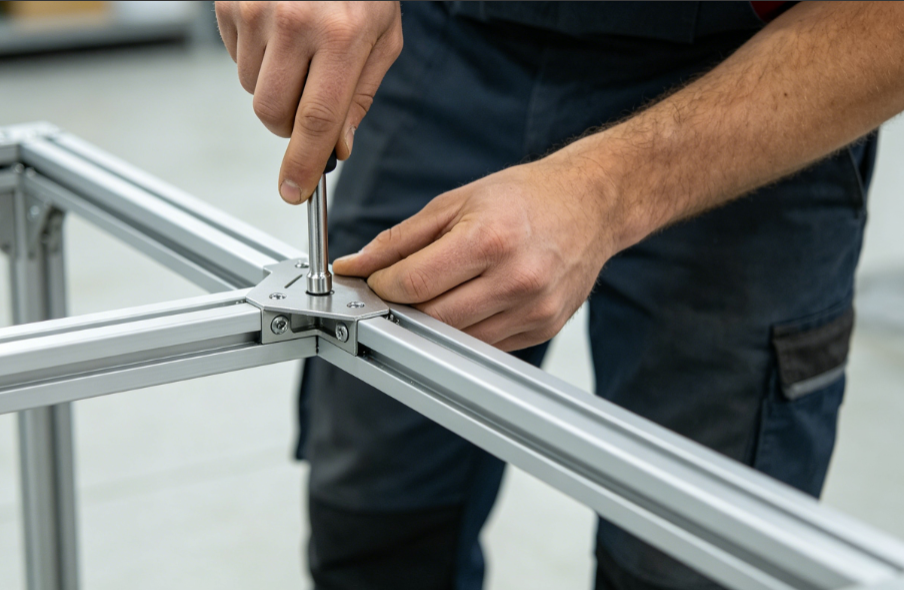
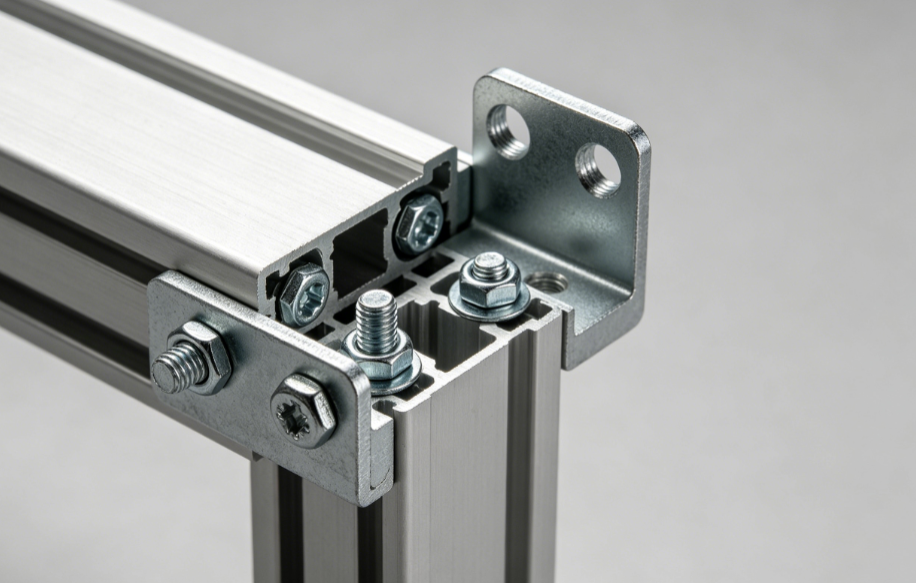
During the installation process, the corner pieces shall be placed symmetrically and accurately aligned to ensure that the corner pieces are completely attached to the two profiles without hanging offset gaps.Maximize the force contact area and effectively improve the structural strength and stability of the splicing joints. Complex multi-node splicing structure, can be temporarily fixed and calibrated with the help of special fixtures, adjust to the overall square alignment and then tighten the bolts.Effectively avoid the problems of structural skew, uneven stress and local overload after installation.
Follow Standard Torque Tightening Specifications
Installation should strictly follow the manufacturer's standard torque parameters to tighten bolts, moderate control force.Too loose tightening will lead to loose connection, too tight will squeeze deformed profile slots and corner pieces, causing irreversible damage. It is suggested to adopt cross symmetrical fastening method for large area frame structure to ensure uniform force at each point.After the equipment is put into trial operation for a period of time, the torque needs to be re-checked twice, and the loose bolts need to be tightened in time to ensure structural stability.
Do a Good Job of Protection and Detection
Outdoor, humid, acid and alkali corrosion conditions, a full set of stainless steel fasteners and anti-corrosion special corner pieces.Avoid the problem of corrosion and aging failure of accessories after long-term use, and ensure the safety and stability of the overall structure. Load test and precision calibration must be completed before the equipment is put into operation.After confirming that there is no deformation of the structure, no loosening of nodes and accurate size, it can be officially put into production and use to avoid failure risk.
Common Mistakes to Avoid
Parts and Profile Specifications Do not Match
Most of the construction failures are caused by the mixing of accessories and profile specifications. Forced assembly of corner pieces of different series and slot size will cause insufficient fit and uneven stress.It directly leads to a significant decrease in the bearing capacity of the structure and buries potential safety hazards. It is a common construction error to select and install products without carefully checking product parameters before construction and blindly relying on experience.In the later stage, it is easy to have problems such as loose structure and frame deformation, which greatly increases the rework cost and equipment safety risk.
Underestimation of Actual Load Requirements
Many constructors choose light standard corner fittings only based on conventional experience, ignoring complex conditions such as dynamic load, continuous vibration and sudden impact of equipment.The load capacity of the selected accessories cannot match the actual working conditions, which is easy to cause failures. When light angle fittings are applied to heavy duty industrial scenes, failures such as deformation of angle fittings, fracture of bolts and looseness of joints frequently occur during long-term operation.It seriously affects the stability of equipment operation and threatens industrial production safety.
Insufficient Surface Treatment and Splicing Accuracy
Construction under the condition that the profile slot is dirty, the port is not deburred, and the cutting angle is skewed will lead to loose fitting of the corner pieces and hidden gaps.It directly destroys the structural force balance and greatly reduces the overall structural stability and bearing capacity. Seemingly small splice deviations and fit gaps will continue to amplify and deteriorate during long-term vibration operation of the equipment.Eventually, serious problems such as overall frame skew and loose nodes will be caused, which will greatly shorten the service life of equipment.
Bolt Tightening Operation is not Standard
Improper bolt tightening strength control is a high-frequency construction problem, insufficient tightening strength will lead to node loosening and structural shaking.Excessive force will crush the profile slot and corner pieces, resulting in irreversible structural damage. Under vibration condition, no anti-loosening measures are adopted, screw thread rubber is not applied, and self-locking accessories are not installed, which is a typical construction omission.After long-term vibration operation of equipment, bolts are easy to loose and fall off, which directly causes equipment failure and shutdown.
Structural Design Layout Unreasonable
Some construction designs rely too much on single-specification corner fittings, core load-bearing nodes are not reinforced, and complex special-shaped structures do not use suitable multi-angle fittings.As a result, the overall structural stability is insufficient and cannot adapt to severe working conditions. One-sided pursuit of simple and beautiful appearance, deliberately simplify the structural design, neglect the convenience of later maintenance.It will lead to a significant increase in the difficulty of equipment rectification, accessory replacement and troubleshooting in the later stage, and increase the long-term operation and maintenance cost.
Why Source Angle Connectors from a Professional Aluminum Profile Manufacturer
High Quality Materials and Strict Quality Control Guarantee
Regular professional manufacturers use high-quality primary alloy, aluminum raw materials, with standardized precision production technology.Production of corner pieces bearing capacity, corrosion resistance, anti-aging, comprehensive performance far more than ordinary miscellaneous low-cost products. Brand manufacturers of corner products through multi-channel quality testing and performance sampling, accurate parameters, stable quality.It can adapt to industrial heavy load, high vibration and outdoor harsh complex working conditions for a long time, and has strong reliability.
Provide Professional Technical and After-sales Support
Brand manufacturers are equipped with professional engineering and technical service teams, which can provide free selection guidance, installation scheme and load parameter reference.Quickly solve all kinds of technical problems in project construction and reduce construction error rate. At the same time, manufacturers can provide CAD drawings, standard installation tutorials and other supporting materials, and the after-sales system is perfect.It can quickly respond to various follow-up needs such as project rectification, equipment transformation, and non-standard customization, and service guarantees are in place.
Long-term Use of Cost-effective Advantages
Professional brand corner parts although a single purchase price is slightly higher, but the product quality is stable, the failure rate is very low.It can greatly reduce the extra hidden cost caused by later rework maintenance and parts replacement, and the comprehensive cost performance is higher. Original matching corner parts can be repeatedly disassembled, recycled reuse, service life far beyond miscellaneous accessories.Long-term use can effectively reduce the comprehensive cost of equipment operation and maintenance and parts iteration, and the long-term economic benefits are very significant.
Compliance Certification and Traceability Assurance
Regular manufacturers of corner products have a complete quality inspection certification and batch traceability system, all parameters up to standard.Fully comply with industrial safety, green production standards, adapt to medical, food, precision manufacturing and other strict compliance industries. No quality assurance, no traceability system, uneven product performance parameters.Applied to industrial core equipment, it is easy to cause structural failures, safety accidents, and compliance acceptance risks.
Technology Iteration and Customized Services
Professional manufacturers continue to invest in technology research and development, continuously optimize product technology, and launch new high-precision, lightweight and specialized corner parts.Keep up with the technological development trend of industrial modularization and intelligent construction. For all kinds of non-standard special engineering projects, manufacturers can provide exclusive customized parts production services.Effectively solve complex construction problems that cannot be adapted to general accessories, and meet the needs of personalized project construction.
Conclusion
To sum up, industrial aluminum angle fittings have become the preferred accessories for aluminum profile assembly by virtue of multiple core advantages such as stable structure, efficient installation, flexible reuse, and outstanding cost performance.Perfect for most industrial modular building scenarios.In practical engineering application, reasonable selection, standard installation and optimal purchase of original angle parts can comprehensively improve the safety and durability of aluminum profile equipment structure.Assist industrial modularization, intelligence,
Henan Retop Industrial Co., Ltd. Will Be There Whenever Wherever Whatever You Need

 How to Choose the Right Angle Connector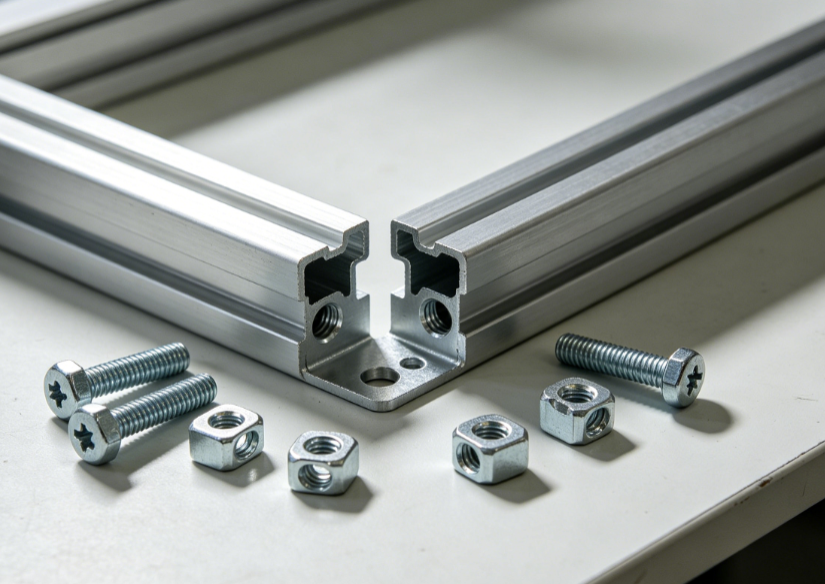
 Why Source Angle Connectors from a Professional Aluminum Profile Manufacturer