Why Aluminum Profiles Dominate NEV Body Manufacturing
Date:2026-06-29
View: 2102 Point
The new energy vehicle industry is rapidly upgrading, and vehicle lightweight has become the focus of research and development. The traditional steel body has been unable to meet the new demand, aluminum profiles due to the advantages of lightweight and high strength, gradually replacing steel as the core body material. As the market expands and technology matures, the application of aluminum profiles has a bright future.
The Growing Demand for Lightweight NEV Manufacturing
The Core Necessity of Lightweight Design
The weight of the battery pack of new energy vehicles increases the load of the whole vehicle, restricting range, handling and energy consumption, aggravating wear and tear, and affecting long-term performance and lifespan. Reducing the weight of the vehicle body by 100 kilograms can improve the range of new energy vehicles by 10%-15%, and the energy consumption efficiency by more than 3.5%. Lightweighting can both optimize performance and reduce battery costs, helping car companies balance performance and economy, with significant industrial value.
Core Features of Lightweighting
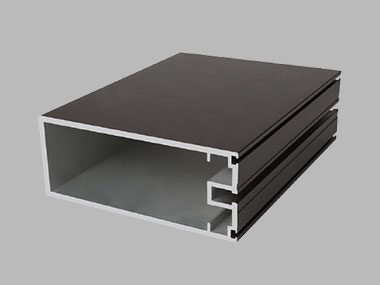
The density of aluminum profile is one-third of that of steel, which reduces the weight of the body while maintaining high strength, and combines corrosion resistance, high thermal conductivity and high toughness. Its comprehensive performance meets the demand for lightweighting of new energy vehicles, and can solve the performance problems brought by the weight increase of batteries. Aluminum profiles can be extruded into a multi-cavity one-piece structure that integrates load-bearing, heat dissipation and component installation. This design reduces the number of parts and assembly processes, and achieves lightweighting while ensuring safety.
Market Growth Trend
The development of new energy vehicles has accelerated the research and development of automobile enterprises, driving the growth of the automotive aluminum profile market. The average annual growth rate of automotive aluminum profiles is more than 8%, and the volume of body structure and collision avoidance systems and other components has risen significantly. It is predicted that in 2030, the global average usage of single-vehicle aluminum profiles will increase to 250 kg, a significant increase over 2020. New energy commercial vehicles due to both load and range, aluminum carrying higher, is the main growth driver.
What Makes Aluminum Profiles Ideal for NEV Production
Advantageous Mechanical Properties of Light Weight and High Strength
Compared with traditional steel, aluminum profile has lower density, which can achieve 40%-50% weight reduction of the body while ensuring structural strength. Its lightweight ability can effectively offset the self-weight of EV battery and optimize the load of the whole vehicle. High-strength aluminum alloy profiles are optimized to have a good strength-to-weight ratio, which can lighten the body and improve range and handling performance.
Excellent Thermal Management Adaptability
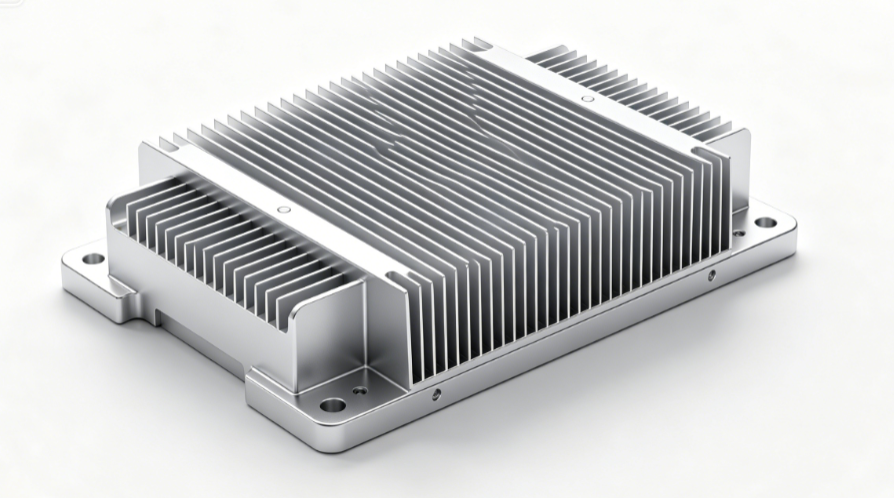
Aluminum has excellent thermal conductivity that far exceeds that of steel, and can quickly channel the accumulated heat, effectively avoiding potential safety hazards such as thermal runaway of the battery and high-temperature degradation of components. Aluminum profiles created through precision extrusion process can integrate customized cooling channels inside the components to build an integrated and efficient heat dissipation structure for the whole vehicle. It can accurately regulate the working temperatures of the battery and motor, so that the three electric systems are always in the best operating state, and significantly extend the service life of the core components.
Long-lasting and Durable Anti-corrosion and Damage Resistance
Aluminum profiles can independently generate a dense and stable oxidized protective film in the natural environment, which can withstand the corrosion damage caused by rain, road salt erosion, alternating high and low temperatures, and other complex working conditions without the need for additional heavy anticorrosion coatings. This natural anticorrosive property greatly enhances the environmental adaptability of the components. This feature is especially suitable for chassis, battery shell, body bottom and other long-term exposure of the core components, to maintain the structural integrity of the components and stable performance over time. This effectively reduces the maintenance cost of vehicle overhaul and replacement, and comprehensively improves the long-term service stability and durability of new energy vehicles.
Flexible and Efficient Design and Manufacturing Advantages
The aluminum extrusion process supports the integrated molding of various types of complex shaped cross-section structures, and can integrate multiple functions such as mounting points, wiring slots, reinforcement, and heat dissipation channels in a single component. Completely abandon the traditional steel multi-part splicing mode, significantly reducing the number of body parts and welding assembly process. Aluminum profile supporting molds have lower molding costs and shorter iteration cycles, which can be quickly adapted to the modularization and platformization of new energy vehicle R&D and production modes. This helps automobile enterprises to quickly complete model revisions and new product iterations, significantly improving the efficiency of vehicle R&D and mass production, and adapting to the rapidly changing needs of the market.
Green and Low-carbon Recycling Value
Aluminum profile is one of the most recyclable metal materials in the automotive industry, and the energy consumption of aluminum recycling is only about 5% of the energy consumption of virgin aluminum production. It can significantly reduce the power consumption and carbon emission of the whole vehicle production process, practicing the concept of low-carbon production. This green and low-carbon material characteristic is highly suitable for the environmental protection development of the new energy automobile industry, and can help automobile enterprises to successfully achieve the goal of carbon neutrality and carbon emission reduction. At the same time, it is in line with the current consumer concept of green transportation, effectively enhancing the market competitiveness of the model.
Major Applications of Aluminum Profiles in NEV Bodies
Battery Shell and Tray
Battery system is the core component of new energy vehicles, and it is also one of the most widely used scenarios for aluminum profiles. Aluminum profiles can be processed to make key components such as battery bezel and bottom bearing tray. Aluminum profiles can be processed to produce key components such as battery bezels and bottom carrying trays, etc. They can protect the battery module in an all-round way and avoid damage caused by external impact. Compared with the traditional steel battery shell, aluminum battery structure can achieve about 50% weight reduction, lightweight advantage is very prominent. At the same time, the aluminum profile battery structure has the core performance of impact protection, corrosion resistance, and efficient heat dissipation, which is perfectly suited for the long-term stable operation of the new energy battery system.
Chassis and Body Frame Structure
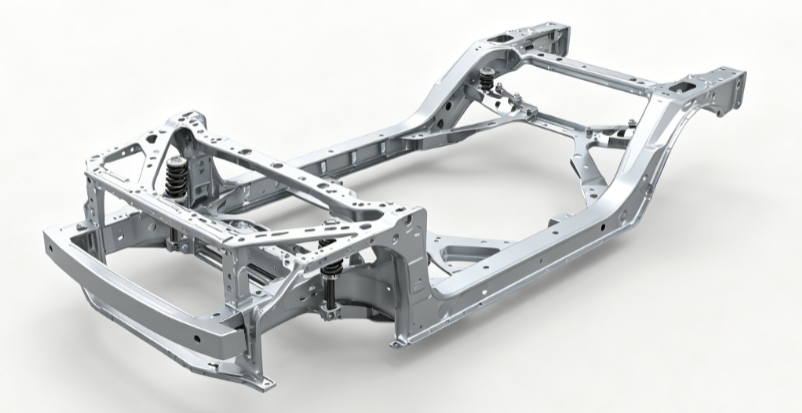
In the chassis and body frame system of new energy vehicles, aluminum profiles are widely used in core load-bearing structures such as longitudinal beams, door sill protection beams, front and rear subframes, and chassis support frames. Relying on the advantages of the profiles, a lightweight and highly rigid chassis load-bearing system is constructed, which strengthens the foundation of the whole vehicle's performance. Multi-cavity extruded aluminum profiles can accurately optimize the wall thickness and internal reinforcing structure layout according to the body stress. Under the premise of significantly reducing the weight of the chassis, it effectively improves the chassis' load-carrying capacity, deformation resistance and impact resistance to ensure the stability and safety of the entire vehicle.
Body-in-White and Safety Protection Structure
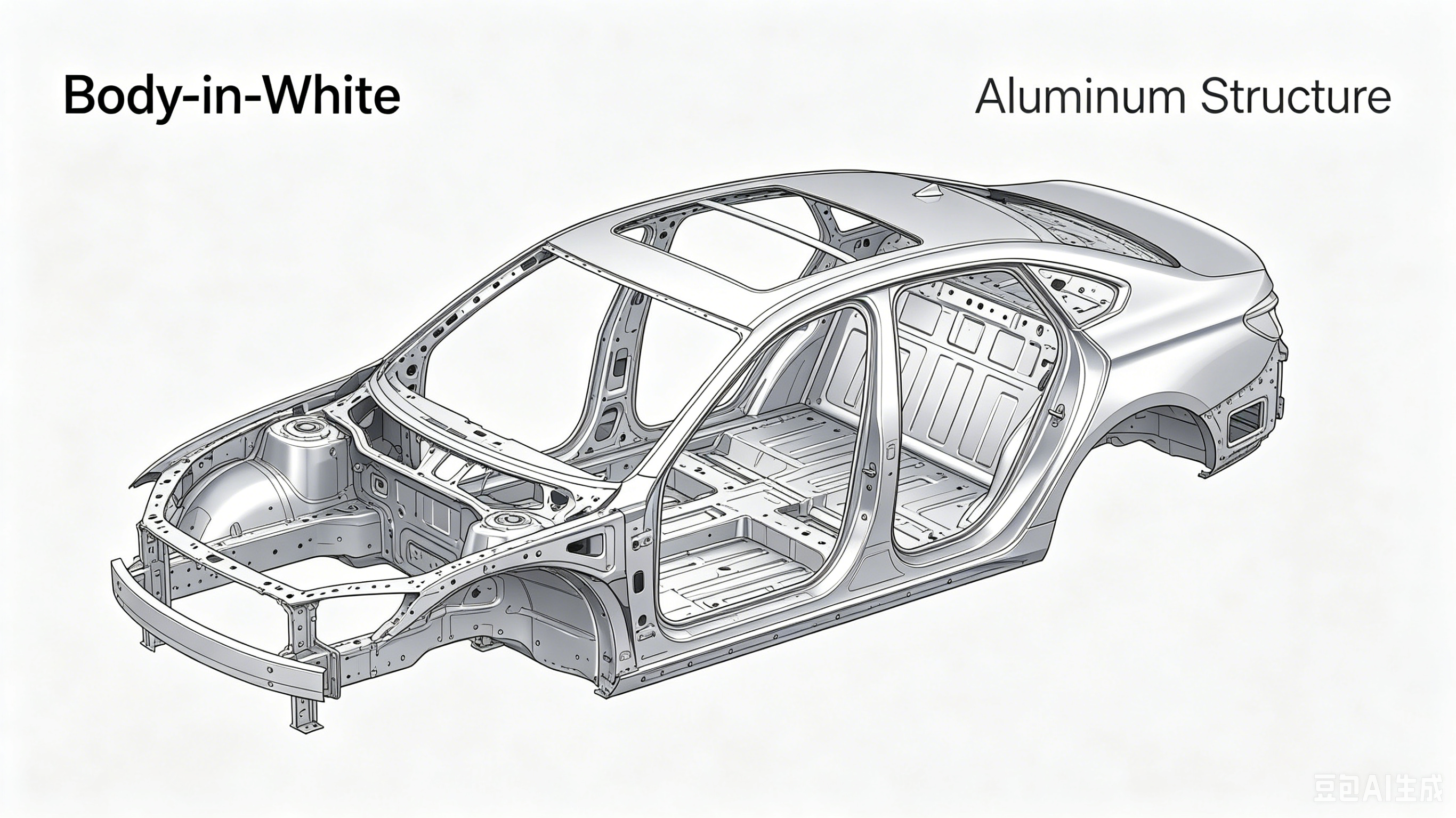
Most of the core safety components of the body-in-white of new energy vehicles are made of high-strength aluminum profiles, including roof beams, ABC column reinforcements, front and rear impact beams, side enclosure protection structures and other key parts. It can effectively strengthen the overall rigidity of the car body and improve the car's collision resistance. The unique structural characteristics of the aluminum profile give it excellent collision energy absorption effect, which can quickly and orderly dissipate the impact force when the vehicle is hit. It can not only protect the main body structure from serious deformation, but also accurately protect the high-voltage battery components, avoiding major safety accidents.
Body Support and Commercial Vehicle Expansion
In addition to the core structure, aluminum profiles can also be adapted to body suspension connectors, heat dissipation support components, door and tailgate support frames, and other ancillary components, providing an all-round coverage of the body material scene. Aluminum profiles can be used to reduce the weight of the entire vehicle from the details and systematically realize the goal of lightweight transformation of the entire vehicle. In electric buses, electric trucks and other commercial new energy models, the application value of aluminum body frames is more prominent. Not only can it significantly reduce the dead weight of the body, enhance the vehicle's cargo and passenger capacity, but also strengthen the durability of the body, which is suitable for the high-frequency and long-mileage operating conditions of commercial vehicles.
How Aluminum Profiles Improve Vehicle Performance
Improvement of Range and Energy Efficiency
The extreme lightweight characteristics of aluminum profiles can significantly reduce the weight of the entire vehicle, effectively offsetting the weight gain and energy consumption pressure brought about by large-capacity battery packs. Under the premise of unchanged battery capacity, the range of new energy vehicles can be significantly improved, alleviating users' mileage anxiety. After a large number of industry tests and verification, the vehicle weight reduction of 10% can make the new energy vehicle energy consumption efficiency increase by 6% -8%, energy saving effect is very significant. Long-term driving can significantly reduce the vehicle's power consumption, reduce the user's cost of using the vehicle, and at the same time enhance the vehicle's energy-saving and environmental protection attributes.
Strengthening the Stability of Vehicle Thermal Management
The integrated aluminum heat dissipation structure can accurately cover the battery, motor, electronic control and other core heat generating components, and regulate the working temperature of core components in real time. It can effectively avoid performance degradation and power limitation under high-temperature environment and fast-charging conditions, and ensure the stable output of the whole vehicle. Stable temperature control effect in the whole area can make the three electric systems in high-speed driving, continuous fast charging and other high-intensity working conditions to maintain the best working condition. It effectively slows down the aging speed of the battery, reduces the probability of failure of the electronic control and motor, and significantly extends the service life of the core system of the new energy vehicle.
Upgraded Collision Safety Protection Capability
The high-strength aluminum profile has excellent collision energy absorption capability through the scientific cavity structure and wall thickness optimization design. When a vehicle collision occurs, the profile can dissipate the impact force in an orderly manner through controlled deformation, minimizing the deformation and damage of the main body structure. The exclusive aluminum profile protection structure of the battery compartment can firmly fix and wrap the battery module, forming an all-round safety barrier. This effectively eliminates major safety risks such as battery breakage, electrolyte leakage and thermal runaway fire after a collision, and comprehensively improves the safety level of the entire vehicle.
Improved Ride Quality and Vehicle Durability
The lightweight body with high-precision optimized aluminum structure can effectively weaken the vibration and noise transmission during driving and optimize the NVH performance of the whole vehicle. It completely improves the problems of high noise and strong sense of bumps in traditional models, and significantly improves the riding comfort of drivers and passengers. Relying on the natural anticorrosion and antioxidant properties of aluminum, the chassis and exposed aluminum body components can maintain stable performance for a long time without being affected by complex road conditions and climate. This effectively reduces the aging and corrosion problems of the components, and greatly extends the service life of the whole vehicle.
Manufacturing Benefits of Aluminum Extruded Profiles
One-piece Molding for Streamlining Parts
The advanced aluminum extrusion process can be integrated to form all kinds of complex shaped functional structures, and can integrate the functions of multiple scattered small parts into a single profile component. This completely changes the traditional steel assembly mode of splicing multiple parts, and significantly reduces the body welding and assembly process. The streamlining of the number of parts can effectively reduce the pressure of parts procurement, warehouse management and supply chain control of automobile enterprises. At the same time, it reduces the accumulation of errors brought about by multi-part assembly, and comprehensively improves the integrity, consistency and stability of the body structure.
Production Advantage of Cost Reduction and Efficiency
The research and development cost and iteration cost of aluminum extrusion die is much lower than that of traditional automobile stamping die and casting die, which can significantly reduce the initial research and development investment of the model. At the same time, the mold modification and new product iteration speed is faster, which is suitable for the production needs of automobile enterprises for rapid model change and new product landing. Aluminum extrusion molding high yield, follow-up secondary processing, grinding and finishing processes less, can effectively save production materials and labor costs. Aluminum can be recycled indefinitely, controlling the comprehensive production cost of new energy vehicle mass production in an all-round way.
Strong Adaptability for Large-scale Mass Production
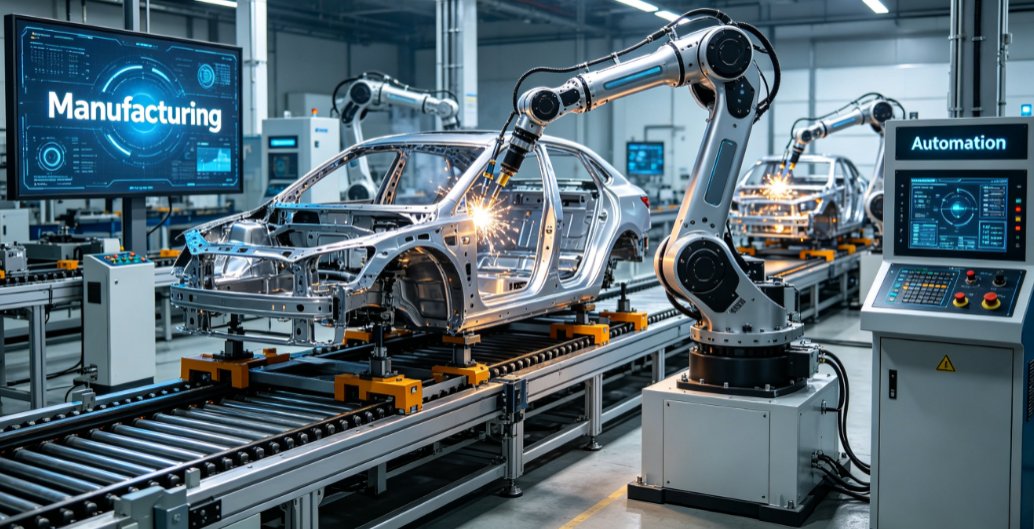
The modern aluminum extrusion line has a high degree of automation and fast production speed, and can realize large-volume and uninterrupted mass production after completing the mold debugging. With automated cutting and finishing equipment, it can guarantee the uniformity of the size and performance of the batch products. The development cycle of customized aluminum profiles is short, which can be quickly adapted to the R&D and production of new modular platform models of automobile enterprises. This is a perfect match for the large-scale mass production demand brought about by the explosive growth in the sales of new energy vehicles around the world.
High-precision Production and Quality Assurance
Precision aluminum extrusion process can achieve micron-level processing tolerances, high dimensional accuracy and flatness of profiles, and strong adaptability of components. It can be perfectly adapted to modern automated automobile assembly lines, guaranteeing the assembly precision of the whole vehicle. With the exclusive heat treatment, anodic oxidation and other surface treatment processes, the mechanical properties and surface quality of aluminum profiles can be precisely regulated. The strength, toughness and anti-corrosion properties of each batch of profiles are kept uniform, realizing stable and controllable quality of products.
Green Production to Match the Industrial Trend
Automotive aluminum profiles have already formed a mature closed-loop recycling system, and the production of recycled aluminum requires only a small amount of energy, which can significantly reduce carbon emissions and energy consumption in the production process of automobile enterprises. Helping car companies to realize green low-carbon production transformation. This green production model is highly suitable for the low-carbon development of the new energy automobile industry. Not only can it help car companies meet the requirements of environmental regulations in various countries, it can also accurately match the market demand for green consumption and enhance the brand's environmental image.
Aluminum Profiles Compared with Traditional Steel Structures
Self-weight and Energy Performance
Traditional steel has high density and high deadweight, and the adoption of an all-steel body structure will significantly increase the vehicle load of new energy vehicles. Excessive body weight will directly aggravate power consumption, compress the vehicle range, and restrict the core performance of new energy vehicles. Aluminum profile weight is only one-third of steel, which can achieve the ultimate weight reduction under the same structural size and load-bearing strength. It can solve the pain point of high energy consumption and short range of steel body from the root, and significantly improve the range performance and energy economy of new energy vehicles.
Strength and Safety Performance
The absolute rigidity and hardness of steel is high, suitable for making simple structure and ultra-high load body parts, but the material specific strength is low. However, the specific strength of the material is low. There is very little room for lightweight transformation, which is unable to meet the core development needs of new energy vehicles in terms of weight reduction and quality improvement. High-strength aluminum profiles have superior specific strength, and with the optimized multi-cavity structure, the collision energy absorption effect is far superior to that of steel of the same weight. While realizing the light weight of the body, it can guarantee and even upgrade the safety protection performance of the whole vehicle, and the comprehensive advantages are more prominent.
Thermal Management and Anti-corrosion Performance
Steel has extremely poor thermal conductivity, which cannot meet the efficient heat dissipation requirements of the battery and motor system of new energy vehicles, and is prone to cause high-temperature failure of components. At the same time, steel is easy to rust and corrode, and must be additionally coated with anticorrosion coating, which increases the weight and processing cost of the car body. Aluminum profiles have excellent thermal conductivity, which can be perfectly adapted to the design requirements of the thermal management system of the whole vehicle and ensure the constant temperature operation of the three electric systems. At the same time, the natural anticorrosive properties of aluminum profiles do not require additional weight gain, effectively reducing post-processing and vehicle maintenance costs.
Comprehensive Cost and Cost-effectiveness
Although the unit price of raw materials for aluminum profiles is higher than that of ordinary steel, the lightweight advantage can effectively reduce the battery configuration specifications and energy loss of the whole vehicle. At the same time, it reduces the cost of later anti-corrosion maintenance and component replacement, which makes the whole life cycle of the vehicle more cost-effective. With the continuous maturity and popularization of recycled aluminum technology, the procurement cost of aluminum continues to dip, and the price gap with steel continues to narrow. This makes the aluminum lightweight solution more suitable for the commercialization of new energy vehicle mass production.
Adaptation Scene Differentiation
Traditional steel still has irreplaceable application value and is mainly applied to key parts of the car body that have ultra-high loads, core load bearing and do not require lightweight transformation. It can guarantee the basic rigidity and structural stability of the body at a low cost, forming a complementary material. Aluminum profiles, by virtue of the comprehensive advantages of lightweight, high heat dissipation, high safety and easy processing, dominate the core scenarios of body lightweight, battery protection and thermal management. It is the core material with the best adaptability in the current new energy vehicle material program.
How to Choose the Right Aluminum Alloy for NEVs
6000 Series
6000 series aluminum alloy is the most widely used main profile for new energy vehicles, with balanced and stable overall comprehensive performance, and supports heat treatment and strengthening process. At the same time, it has excellent weldability, processability and corrosion resistance, and is suitable for most body components. Among them, 6061 and 6082 alloys have higher strength and are mostly used for core load-bearing parts such as battery trays and body frames, while 6063 alloy has better surface texture and stronger molding properties, and is mainly suitable for exterior decoration and low-load protection parts.
5000 Series and 7000 Series
5000 series aluminum alloys do not require heat treatment, and have excellent formability and corrosion resistance, as well as strong weather resistance. It is mostly used for lightweight components that do not require high load-bearing strength, such as interior body panels and chassis protection panels, but require high anti-corrosion molding. 7000 series aluminum alloy is currently the highest strength of the automotive alloy series, mechanical properties far beyond the ordinary aluminum. It is specially used for the core safety components that require high crash protection performance, such as impact beams, body reinforcements, column protection, and so on.
Other Series
3000 series aluminum alloy has simple forming process, low cost, stable performance, good toughness and corrosion resistance. It is mainly used for simple heat dissipation accessories, general protection shells and other basic auxiliary parts with lower performance requirements. With the material technology iteration, the new high-strength modified 6000 series alloy is gradually applied, retaining excellent processability while improving strength and toughness. It is widely used in high-end new energy models, combining extreme lightweight and top crashworthiness.
Precise Selection of Components
The battery system of new energy vehicles has stringent requirements on the comprehensive performance of materials, and the industry generally prioritizes the use of 6000 series alloys. This series of alloys can perfectly balance structural strength, heat dissipation performance, processing performance and anti-corrosion ability, and is suitable for long-term stable working conditions of batteries. For car body collision and impact protection structures, high strength 7000 series alloys or high toughness 6000 series alloys are preferred. It can maximize the collision energy-absorbing capacity and structural stability of the components, and guarantee the crash safety performance of the whole vehicle in an all-round way.
Future Trends in Aluminum Profile Applications for NEVs
New Aluminum Alloy Material Innovation
Aluminum material technology continues to be iterative, and recycled aluminum alloys with high strength and high toughness, low energy consumption and low carbon emissions will gradually replace traditional profiles. While significantly improving the structural performance of the car body, it also reduces the carbon emission of the whole car production, which is in line with the goal of carbon-neutral development. For ultra-fast charging, solid-state batteries and other new-generation technologies, special heat-conducting aluminum alloys continue to be landed, which can be adapted to the heat dissipation needs of high-energy-density batteries. It further optimizes the stability of the three electric systems and helps upgrade the performance of new energy vehicles.
Intelligent Thermal Management System Integration
In order to adapt to the development trend of ultra-high-speed fast charging and high-energy-density batteries, future aluminum profiles will integrate more precise and complex built-in heat dissipation runners. It can realize full-area and high-efficiency heat dissipation, and solve the problem of high temperature of the battery under high load conditions. Some of the high-end profiles will also integrate phase change materials and intelligent temperature control structure to achieve precise dynamic regulation of battery temperature. Completely eliminate high-temperature degradation, low-temperature starting difficulties and other problems, and ensure the stability of the vehicle under all working conditions.
Popularization of Multi-material Composite Intelligent Design
The future body design will popularize the multi-material composite program, and the aluminum profile will be mixed and matched with high-strength steel, carbon fiber composite materials, and polymer materials. According to the different parts of the body force, heat dissipation, protection needs zoning material selection, accurate optimization of performance. Relying on AI topology optimization and intelligent generation design technology, the structural design of aluminum profiles will be more scientific and accurate. It can accurately match the stress points of the body, maximize structural safety while minimizing weight, and achieve the optimal performance ratio.
Intelligent Manufacturing and Low-carbon Production Upgrade
Industry 4.0 intelligent manufacturing technology will fully empower the aluminum profile production line, realizing real-time control of the production process, intelligent debugging, fault warning. It will effectively improve the precision, yield rate and production efficiency of mass production of aluminum profiles, and meet the mass production demand of high-end models. The automotive aluminum closed-loop recycling system will be fully popularized, and the aluminum recycling rate of automobile enterprises will be greatly improved, effectively reducing production energy consumption and carbon emissions. Promote the new energy automobile industry to form a low-carbon, sustainable green production ecology.
Conclusion
Aluminum profiles are suitable for the lightweight demand of new energy vehicles due to its advantages of light weight, high strength, anti-corrosion and easy processing, and its comprehensive performance is better than that of traditional steel. With the upgrading of materials and technology, its advantages will be further expanded to promote the high-end and green development of new energy automobile industry.
Henan Retop Industrial Co., Ltd. Will Be There Whenever Wherever Whatever You Need

 Major Applications of Aluminum Profiles in NEV Bodies
 Manufacturing Benefits of Aluminum Extruded Profiles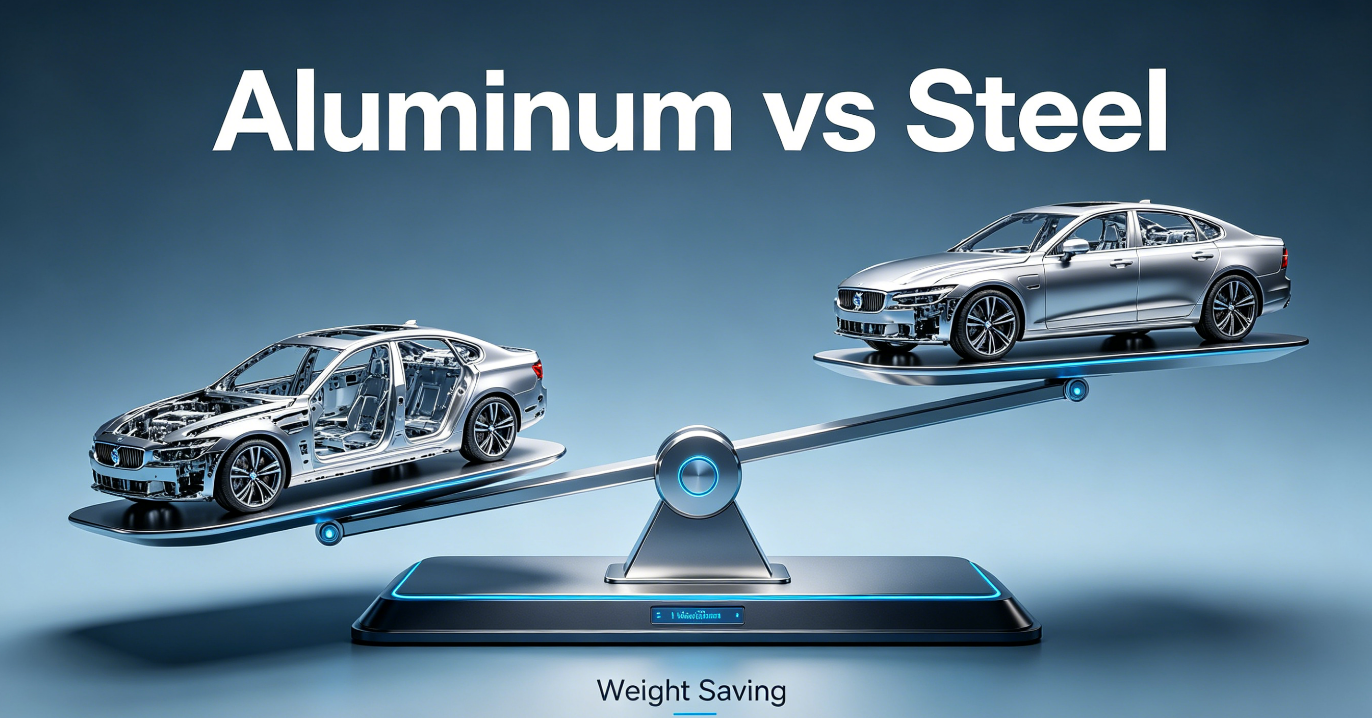
 Future Trends in Aluminum Profile Applications for NEVs